Object Lesson on God's Love: A Hands-On Approach to Understanding Divine Affection
Object Lesson on God's Love: A Hands-On Approach to Understanding Divine Affection
Have you ever felt overwhelmed trying to explain the vastness of God's love to children? It's an abstract concept, difficult to grasp, especially for young minds. This article explores a simple yet powerful object lesson that uses everyday materials to visually represent the expansive and ever-present nature of God's love, making it tangible and relatable for children of all ages.
The Paper Towel Demonstration: A Visual Metaphor for God’s Love
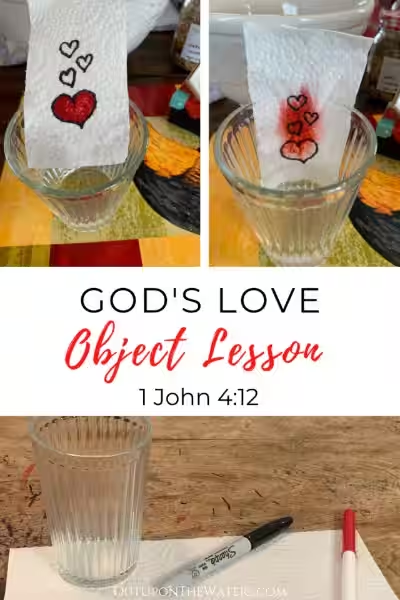
This object lesson requires only a paper towel, water, and red and black markers. Before starting the activity, draw several small black heart outlines on the paper towel. These smaller hearts represent the people in the child's life – family, friends, teachers, even strangers. At the bottom of the paper towel, draw a larger black heart. This larger heart represents the child themselves.
Now, here's where the magic begins. Using the red marker, fill in the large heart completely. This red color symbolizes God's love residing within the individual. Explain to the children that God's love dwells within each of us. It's a foundational truth, a wellspring of love that flows naturally from our hearts.
Next, carefully dip the paper towel into a bowl of water. Watch as the red color starts to bleed, spreading outwards from the large heart to the smaller hearts surrounding it. This visual representation perfectly captures the principle of God's love spreading outwards through us.
The Significance of the Spreading Red Dye
The spreading red dye serves as a powerful metaphor. It illustrates how when we embrace and embody God's love, it naturally overflows into our interactions with others. We become vessels through which God's love is poured out. This isn't about outward performance; it's the natural consequence of having God's love within us. The act of loving others isn't merely a command; it's the organic expression of a heart filled with divine grace.
This simple demonstration powerfully illustrates 1 John 4:19: “We love because he first loved us.” Our capacity to love others stems directly from God’s prior love for us. It's a reciprocal relationship; God's love is the source, and our acts of love are the outflow. This is further reinforced in 1 John 4:12: “If we love one another, God lives in us, and his love is made complete in us.”
Expanding the Lesson: Discussion and Application
This object lesson is just the beginning. It's crucial to facilitate a meaningful discussion with the children, encouraging reflection and personal application. Ask questions like:
Who are the people represented by the smaller hearts?
How do you show love to these people?
How do you know God loves you?
Can you think of times when you've seen God's love spread through your actions?
These questions encourage children to connect the visual representation to their personal experiences and understanding of God's love. This interaction solidifies the lesson’s impact, turning it from a passive observation into an active exploration of faith.
Incorporating Biblical Principles
To deepen the children's understanding, integrate relevant scripture. John 3:16 ("For God so loved the world...") is a foundational verse, emphasizing the universality of God's love. Sections from 1 Corinthians 13 (describing the characteristics of love), Proverbs (wisdom on loving relationships), and Romans (God's enduring love) provide further scriptural context and reinforcement. These verses offer rich insights into the nature of love, expanding the lesson beyond the visual demonstration.
Beyond the Paper Towel: Exploring the Immeasurable Nature of God’s Love
While the paper towel object lesson effectively illustrates the outward spread of God's love, it's important to acknowledge the limitations of any physical representation of something so vast and profound. God's love is immeasurable, exceeding human comprehension. Ephesians 3:18 ("...may have power to comprehend with all the saints what is the breadth and length and height and depth, and to know the love of Christ which surpasses knowledge...") highlights this immensity.
The paper towel exercise emphasizes the manifestation of God's love – how it flows through us. It's a starting point for a deeper conversation about the sheer magnitude of God's grace, a love that transcends our understanding and encompasses all of creation.
Extending the Discussion: Breadth, Length, Height, and Depth
To further explore the immeasurable aspect, introduce the four dimensions of God's love described in Ephesians 3:18:
Breadth: God's love extends to everyone, regardless of their background, beliefs, or actions.
Length: God's love endures forever, unwavering and constant.
Height: God's love reaches beyond our understanding, limitless and boundless.
Depth: God's love is profound and intense, going far beyond superficial affection.
These concepts, while potentially abstract, can be made accessible to children through storytelling, relatable examples, and further visual aids. The goal is to instill a sense of security and unwavering faith in God's unconditional love. The paper towel exercise is a springboard to a deeper, more meaningful engagement with the concept of divine love. It is a powerful tool, but it's only the beginning of a life-long journey of understanding and experiencing the immeasurable love of God.
Here's an FAQ section about an object lesson on God's love using a paper towel, water, and markers, based on your provided information.
What materials are needed for this object lesson on God's love?
You will need a paper towel, black markers, red washable marker or paint, and water.
How do I set up the object lesson?
Draw several small black heart outlines on the paper towel. At the bottom, draw a larger black heart outline. This larger heart represents the individual, and the smaller hearts represent other people in their life.
How does the object lesson visually represent God's love?
Color the large heart red. This red represents God's love within the individual. Then, dip the paper towel into water. Watch as the red color spreads from the large heart to the smaller hearts. This visually demonstrates how our love for others (fueled by God's love within us) spreads God's love to others.
What biblical principles does this object lesson illustrate?
The lesson illustrates 1 John 4:19 ("We love because he first loved us") and 1 John 4:12 ("If we love one another, God lives in us, and his love is made complete in us"). It shows how God's love is the foundation for our love for others and that our actions of love reflect God's presence in our lives.
What discussion points can I use with children after the object lesson?
Ask children who they love, how they show love, and how they know God loves them. You can also discuss various Bible verses such as John 3:16 (God's love for the world), verses from 1 Corinthians 13 (characteristics of love), Proverbs, and Romans (God's enduring love). Encourage reflection on personal experiences related to love and God's love.
What is the overall goal of this object lesson?
The object lesson aims to make the abstract concept of God's love more tangible and relatable for children. It helps them understand that God's love is not only a feeling but also an action that spreads outwards when we show love to others. It bridges the gap between the theoretical understanding of love and its practical application.
Why is this object lesson effective?
Its simplicity and visual nature make it easily understood and memorable for children. The hands-on activity makes learning engaging, and the readily available materials make it easy to replicate in different settings.
Are there alternative ways to illustrate the expansive nature of God's love?
Yes, while this lesson focuses on the spreading of love, other lessons could use visual aids like a large container overflowing with smaller items, or a progressively expanding circle to represent the vastness and boundless nature of God's love, as described in Ephesians 3:18.