Tamarisk Tree Spiritual Meaning: A Legacy of Faith and Selfless Service
Tamarisk Tree Spiritual Meaning: A Legacy of Faith and Selfless Service
The seemingly simple act of planting a tree can hold profound spiritual significance. This is particularly true when considering the biblical account of Abraham planting a tamarisk tree in Beersheba (Genesis 21:33-34). But what exactly is the tamarisk tree spiritual meaning behind this seemingly insignificant act? This article explores the rich symbolism woven into this narrative, revealing a powerful message about faith, legacy, and selfless service.
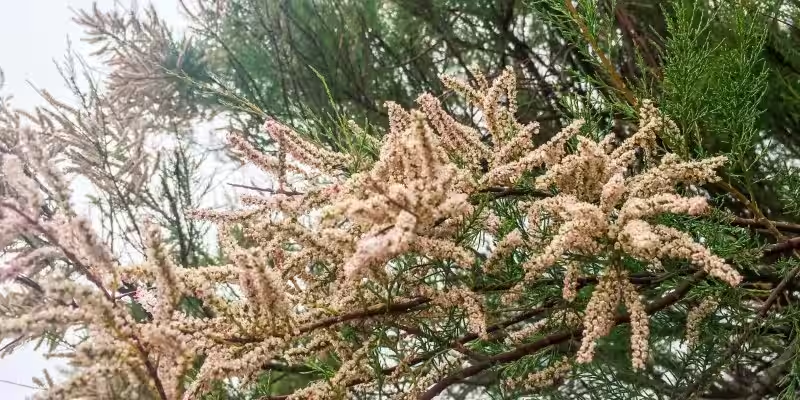
The tamarisk tree, also known as salt cedar, is a resilient plant often found in arid and semi-arid regions. Its ability to thrive in harsh conditions reflects the challenges faced by those who dwell in the desert. However, the biblical tamarisk, particularly the varieties found in the Middle East, differ significantly from the smaller, bushier American tamarisk. The Middle Eastern tamarisk is a larger, more majestic tree, capable of providing substantial shade and sustenance. Importantly, it's a slow-growing tree, taking a remarkably long time—sometimes hundreds of years—to reach maturity.
This slow growth is key to understanding its spiritual significance. Unlike many plants that provide immediate benefits, the tamarisk requires patience, care, and long-term commitment. Abraham's act of planting this tree wasn't about immediate gratification; it was a commitment to future generations. He was planting a legacy, a tangible symbol of his faith in God's promise of the Promised Land. The shade offered by the mature tree wouldn't benefit him directly; it would benefit his descendants.
This understanding aligns with the cultural practices of Bedouin and Jewish communities. Planting a tamarisk wasn't merely a practical act, but a deeply symbolic one, representing faith in the future and a commitment to those who would come after.
Beyond Personal Gain: A Reflection on Selfless Service
The tamarisk tree naturally leads us to a crucial question: how much of what we do in life is done for ourselves, and how much is done for others? Abraham's action serves as a powerful example of selfless service. He planted a tree that he would never fully enjoy the benefits of, an act that transcends personal gain.
This simple act compels us to examine our own lives. Are we primarily focused on immediate gratification, or are we investing in something larger than ourselves? Are we planting "tamarisk trees"—actions that will have a lasting positive impact long after we are gone? This might involve mentoring young people, contributing to charitable causes, creating works of art that will inspire future generations, or simply performing acts of kindness that ripple outwards.
The arid landscape in which the tamarisk thrives mirrors the challenging, yet ultimately rewarding nature of long-term, selfless commitment. Just as the tree endures hardship to provide shade and sustenance, so too can acts of selfless service yield great rewards, even if those rewards are not immediately apparent.
Connecting the Tamarisk to Biblical Themes and Personal Growth
The tamarisk's approximately 400-year lifespan has been linked to the 400 years of Israelite slavery in Egypt, before their exodus to the Promised Land. This connection further strengthens the symbolism of the tree as a testament to faith and perseverance; a symbol echoing God's covenant with Abraham and the eventual fulfillment of His promises. The tree's production of honeydew, a sweet substance likened to manna, reinforces the theme of divine provision and sustenance throughout the Israelites' journey.
The tamarisk's enduring nature also mirrors the importance of passing down faith and knowledge to future generations. This resonates deeply with Psalm 78:5-8 which emphasizes the importance of sharing our faith with those who come after us, ensuring that the legacy of faith continues. The act of planting a tamarisk, then, becomes a tangible expression of this spiritual imperative.
Furthermore, the tamarisk's ability to flourish despite harsh conditions mirrors our own ability to find blessing, even amongst hardship. It's a reminder that even in the face of adversity, we can contribute positively to the lives of others and leave behind a lasting legacy. This aligns with biblical teachings that emphasize the importance of perseverance and faith in the face of adversity.
In conclusion, the tamarisk tree spiritual meaning transcends a simple botanical description. It embodies a profound message of faith, legacy, and selfless service. By reflecting on Abraham's act, we are challenged to consider our own contributions to the world, and to strive to plant our own metaphorical tamarisk trees—leaving behind a legacy of enduring impact for those who come after us.
Frequently Asked Questions: The Spiritual Meaning of the Tamarisk Tree
What is the spiritual significance of the tamarisk tree, based on biblical accounts?
The tamarisk tree, particularly Abraham's planting of one in Beersheba (Genesis 21:33), holds profound spiritual meaning. It's not merely a historical detail, but a powerful symbol of faith, legacy, and selfless service. The slow growth of the tamarisk, taking nearly 400 years to mature, mirrors the Israelites' journey and Abraham's faith in God's promise of the Promised Land. Because he wouldn't live to see its maturity, his act represents a commitment to future generations, prioritizing long-term impact over immediate benefit. This act embodies faith in God's promises and a dedication to building a lasting legacy.
How does the tamarisk tree's characteristics contribute to its spiritual symbolism?
The tamarisk's characteristics are integral to its symbolic meaning. Its slow growth (approximately 400 years to reach maturity) is a key element, echoing the 400 years of Israelite slavery before the exodus and highlighting the virtue of long-term commitment and selfless service. Its ability to thrive in harsh desert conditions symbolizes resilience and the potential for blessing even amid adversity. Furthermore, the tamarisk's shade and potential production of a manna-like substance can be seen as representations of God's provision and care for future generations.
What is the connection between the tamarisk tree and the concept of legacy?
Abraham's planting of the tamarisk is a prime example of creating a lasting legacy. He planted a tree that would not benefit him directly, but would provide shade and sustenance for his descendants, generations later. This selfless act teaches us the importance of creating lasting positive impacts that extend beyond our own lifetimes. It encourages us to consider how our actions today will influence future generations and to engage in activities that benefit others long after we are gone.
How can I apply the symbolism of the tamarisk tree to my own life?
The tamarisk tree serves as a powerful metaphor for how we live our lives. We can reflect on the extent to which our actions are self-serving versus oriented towards benefiting others, especially future generations. The tree encourages us to consider performing selfless acts—investing in the growth and development of others, even if it does not yield immediate results. By focusing on lasting positive impacts, we can echo Abraham's example and create a legacy that extends beyond our own time. This could involve acts such as mentoring, community service, or environmental stewardship, aiming for actions that will benefit others long after we are gone.
Does the location of Abraham's tamarisk tree hold any additional spiritual significance?
The location, Beersheba ("Seven Wells"), adds another layer of meaning. It represented the southern border of the Promised Land, a dry, desert region. Planting a tamarisk in such a harsh environment emphasizes the resilience and endurance of faith, as well as the potential for blessing even in challenging circumstances. This location highlights the enduring nature of God's covenant and the perseverance needed to build a lasting legacy, even in seemingly inhospitable conditions.