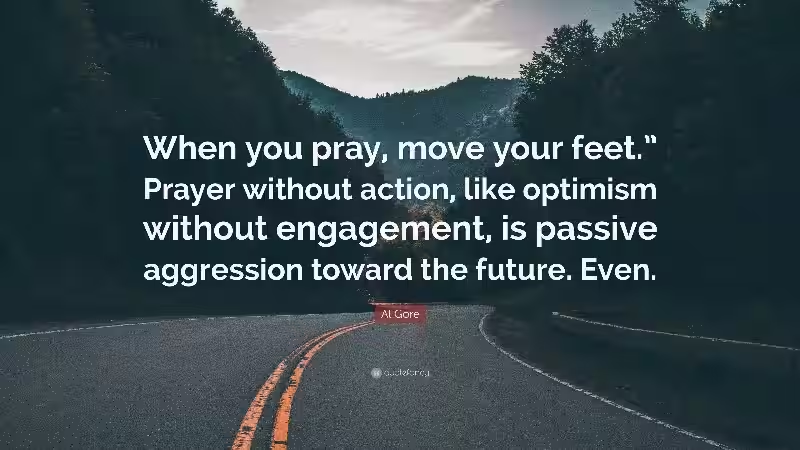
Prayers Without Action: Are Thoughts and Prayers Enough?
Prayers Without Action: Are Thoughts and Prayers Enough?
This article explores the often-debated topic of "thoughts and prayers," specifically examining whether prayers without action are truly effective, particularly in the face of societal challenges like mass shootings and other tragedies. We'll look at both religious and secular perspectives, examining the inherent limitations of prayer alone as a solution to complex problems.
The phrase "thoughts and prayers" has become a common, almost ritualistic, response to tragedy. While offering condolences and expressing empathy is certainly important, the repetitive nature of this response, often without any accompanying commitment to meaningful change, has led many to question its value. It can feel deeply insufficient to those directly affected by tragedy, as well as to those who recognize the need for concrete action.
The problem isn't with prayer itself. Prayer, for many, is a genuine expression of grief, a personal connection to a higher power, and a source of comfort and strength. However, when prayer becomes a substitute for tangible action, it becomes problematic. It risks trivializing the suffering of victims and their families, and deflecting attention from the systemic issues that contribute to these tragedies.
The Bible, while emphasizing the importance of prayer, doesn't advocate for prayers without action. In fact, the concept of faith without works is explicitly addressed in James 2:14-26. This passage highlights that true faith is demonstrated through action, not simply through words or silent prayers. The biblical narratives are replete with examples of individuals whose prayers were answered only when coupled with determined and righteous action. Elijah's prayer for rain, for example, was preceded by his courageous confrontation of the prophets of Baal and his meticulous preparation of the altar (1 Kings 18). Similarly, the parable of the Good Samaritan emphasizes compassionate action as the true measure of faith, not simply pious thoughts.
The Synergistic Relationship Between Prayer and Action
The Biblical perspective suggests a dynamic interplay between prayer and action. Prayer is not a passive activity; rather, it's a catalyst for action. It clarifies our purpose, strengthens our resolve, and inspires us to act in accordance with our faith and values. This is not to say that every prayer must be immediately followed by a visible action. Sometimes, the "action" is internal—a change of heart, a commitment to a new way of life, a deepening of faith. But the key is that prayer should not remain isolated; it should fuel and inform our actions in the world.
The Dangers of Inaction: Why Prayers Without Action Are Insufficient
The cycle of grief, political debate, and ultimately inaction following mass shootings and other tragedies is deeply troubling. While discussions about gun control and other relevant issues are essential, these conversations often become stalled, leaving many feeling helpless and hopeless. This inertia is precisely where prayers without action fail to serve their purpose.
Focusing solely on prayer while ignoring the need for systemic change risks perpetuating the cycle of violence. It’s crucial to actively participate in shaping a more just and equitable society, one in which policies and practices actively mitigate the causes of violence and suffering. The voices of the vulnerable must be heard and prioritized in legislative discussions, ensuring that policy decisions reflect the needs and concerns of all members of society.
Meaningful change requires more than empty platitudes and well-intentioned prayers. It demands active engagement in the political process, advocating for responsible gun control legislation, supporting organizations dedicated to violence prevention, and promoting a culture of empathy and compassion. Furthermore, we must strive to understand and address the root causes of violence, such as poverty, inequality, and mental health issues. This is a monumental task, but one that is essential if we are to create a truly just and safe world. It’s a commitment to active engagement that transforms prayers from empty noise into a powerful force for positive change.
Conclusion: The Power of Prayer in Action
The question isn't whether prayer is valuable; it is undeniably a source of comfort and strength for many. However, the true measure of our faith lies not just in our prayers, but in the actions that stem from them. Prayers without action ultimately remain hollow gestures, failing to address the root causes of suffering and injustice. Only through a concerted effort to translate our prayers into tangible actions can we hope to create a lasting positive impact on the world and build a more peaceful and equitable future for all. The work ahead is vast and challenging, but the potential for positive change is immense when we move beyond mere thoughts and prayers and engage in the difficult, yet necessary, work of building a better world.
Frequently Asked Questions: Prayer and Action
What is the problem with "prayers without action," particularly in response to tragedies like mass shootings?
The problem with offering only "thoughts and prayers" in response to tragedies is that it can be a form of inaction masking itself as a response. While prayer can be a genuine expression of grief and a personal connection with the divine, it becomes insufficient and even harmful when it replaces concrete action to address the root causes of the problem. It risks silencing the need for meaningful change and allowing harmful situations to persist. Essentially, it's a way to feel like you've done something without actually doing anything that effectively addresses the issue at hand.
Does the Bible support the idea of prayer without action?
No, the Bible does not primarily advocate for prayer without action. While prayer is presented as a vital connection with God, numerous biblical examples demonstrate that sincere prayer is consistently coupled with tangible actions that reflect faith. The stories of Elijah and the Good Samaritan exemplify the interconnectedness of prayer and action. James 2:14-26 explicitly states that "faith without works is dead," emphasizing that true faith is evidenced through actions aligned with one's beliefs. The Bible champions a synergistic relationship where prayer inspires and motivates action, and action demonstrates the authenticity of prayer.
Are there instances in the Bible where prayers are answered without immediately apparent corresponding actions?
Yes, there are instances where prayers seem answered without immediately obvious corresponding actions from the person praying. However, these examples often highlight the importance of faith and trust in God's timing and methods. The "action" might be internal – a change of heart or a commitment to God's will – even if outward, visible actions aren't immediately apparent. The key is that the prayer fosters an internal change or a commitment to a course of action, even if the outward manifestation of that action is delayed or indirect.
How can we reconcile the importance of prayer with the need for tangible action?
The ideal is a dynamic interplay between fervent prayer and committed action. Prayer can be a powerful tool for connecting with the divine, clarifying one's purpose, and gaining strength and guidance to act. It should inspire and motivate actions aligned with God's will and one's values. Action, in turn, demonstrates the sincerity and authenticity of one's prayers. The focus should be on the synergistic relationship between the two, not on separating them as distinct and independent activities. Prayer without action is incomplete; action without prayer can be misguided.
What kind of actions are necessary to complement prayer in addressing societal issues like gun violence?
Meaningful action in response to societal issues like gun violence requires moving beyond simple platitudes and engaging in substantive conversations about gun control and societal values. This includes advocating for responsible gun laws, supporting organizations working to prevent violence, promoting mental health initiatives, and working towards a more just and inclusive society where the voices of all, especially the vulnerable, are heard and considered in legislative processes. The specific actions will vary depending on individual capabilities and resources, but the crucial element is active participation in creating positive change.