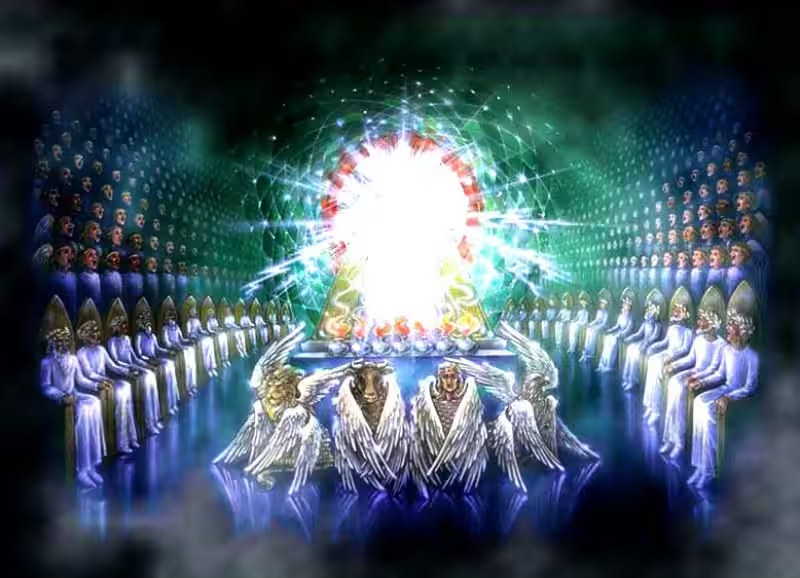
The question of whether there are people in heaven right now is one that has captivated humanity for millennia. Different faiths and theological perspectives offer varying answers, often rooted in interpretations of sacred texts and philosophical reasoning. This exploration aims to delve into this complex question, examining various viewpoints and scriptural interpretations to provide a comprehensive understanding.
Many religions and belief systems address the concept of an afterlife, often including a heavenly realm. However, the specifics of who might be there, and the nature of their existence, vary considerably.
For example, some religions believe in reincarnation, where souls are reborn into new bodies after death, making the idea of a permanent heavenly residence less straightforward. Other faiths may envision a more complex afterlife, encompassing various levels of existence, or a judgment process that determines an individual's ultimate destination. These differences highlight the diverse range of perspectives on this profound question.
Understanding these different views is crucial to approaching the question with nuance and respect for the varying beliefs held by people across the world. The exploration of these diverse perspectives ultimately enriches our understanding of the human search for meaning beyond physical life.
Biblical Interpretations: Immediate Ascent vs. Resurrection
The Bible, particularly the New Testament, offers numerous passages that seem to address the question of what happens after death. However, interpreting these passages can be challenging, leading to varying theological viewpoints. One common interpretation, found in certain Christian denominations, asserts that believers go directly to heaven upon death.
This interpretation often centers on verses like Luke 23:43, where Jesus tells the repentant thief, "Truly, I say to you, today you will be with me in paradise." This is cited as evidence of an immediate entrance into heaven after death for those who have accepted Christ. However, other biblical passages suggest a different understanding. Are there people in heaven right now according to these alternative interpretations? Not necessarily immediately after death.
Some groups, such as Jehovah's Witnesses and some Seventh-day Adventists, hold the "soul sleep" doctrine. This view posits that believers remain unconscious after death until the resurrection, at which point they enter heaven. They argue that certain passages, such as Ecclesiastes 9:5, “For the living know that they will die, but the dead know nothing,” support this interpretation. The understanding of death as a state of unconsciousness, pending resurrection, directly contrasts with the idea of immediate ascension to heaven.
This difference in interpretation highlights the complexities involved in drawing definitive conclusions based on biblical texts. The understanding of key phrases and their contextual meaning can significantly influence the resulting theological viewpoints.
The Concept of Purgatory
Catholic theology introduces the concept of purgatory, a state of purification after death that precedes entry into heaven. This view suggests that those who die in God's grace but still have temporal punishment due to sin undergo a period of cleansing before achieving eternal bliss. This differs from both the immediate ascension and soul sleep doctrines.
The inclusion of purgatory adds another layer of complexity to the question of who is currently in heaven. It suggests that not all who die in faith are immediately present in the heavenly realm, but rather may be undergoing a process of purification before entering heaven.
Scriptural Contradictions and their Resolutions
The Bible contains passages that appear contradictory regarding immediate ascension. For example, John 3:13 states, "No one has ascended into heaven except he who descended from heaven, the Son of Man." This verse is sometimes interpreted to mean that only Jesus ascended to heaven.
However, other passages mention individuals who, according to some interpretations, have been in heaven. Examples include Enoch and Elijah, who were translated without experiencing death, and the souls of martyrs described in Revelation. These apparent contradictions require careful consideration of the context and potential different meanings within the broader narrative. Are there people in heaven right now, and how do we reconcile these apparent contradictions?
These seeming discrepancies can be resolved by understanding the distinction between the "physical" and "spiritual" dimensions. The Bible describes instances of spiritual ascents, like those of Enoch and Elijah, and of a resurrected body ascending to heaven (such as Christ’s). Then there are spiritual presences in the heavenly realm as mentioned in Revelation.
Understanding this distinction clarifies the interpretation of conflicting passages. The "ascension" mentioned in John 3:13 might refer to a specific, unique event related to Jesus's divinity and mission, rather than a denial of other individuals being in heaven in a spiritual sense. These considerations are crucial for understanding the various narratives and interpretations surrounding the afterlife.
Conclusion: A Multifaceted Question
The question of whether there are people in heaven right now is not easily answered with a simple "yes" or "no." Different religious traditions and theological perspectives offer diverse viewpoints, each with its own supporting arguments and scriptural interpretations. The Bible itself presents apparent contradictions that require careful consideration of context and the distinction between physical and spiritual realities.
Ultimately, the belief in a person's presence in heaven, or the nature of the afterlife, often rests on personal faith and the interpretation of sacred texts. The exploration of these diverse perspectives, however, enhances our understanding of the complexities surrounding this profound question and the enduring human yearning for understanding life beyond death.
Frequently Asked Questions: Are There People in Heaven Right Now?
This FAQ addresses the complex question of who is in Heaven, drawing from various scriptural interpretations. It's important to note that different theological perspectives exist on this topic.
What does the Bible say about people being in Heaven right now?
The Bible presents a nuanced picture. Some passages, like Luke 23:43 (Jesus’ promise to the thief), and 2 Corinthians 5:6-8 (Paul's desire to be "at home with the Lord"), suggest an immediate transition to a heavenly realm upon death for believers. Other passages, such as Psalm 115:17, Psalm 146:4, and Ecclesiastes 9:5-6, indicate a state of unconsciousness after death, implying that the deceased are unaware of their surroundings. The accounts of Enoch and Elijah (who were translated to Heaven without dying) and the resurrection of the righteous (as described in various passages) add further complexity. Ultimately, the Bible doesn't offer a single, easily defined answer.
Are believers in Heaven immediately after death?
Different Christian denominations hold varying beliefs. Some believe in immediate entrance into Heaven upon death for believers, based on interpretations of verses like Luke 23:43. Others believe in a state of unconsciousness until the resurrection, citing passages like Psalm 115:17. Still others believe in an intermediate state, such as purgatory (Catholic belief). Therefore, there's no single, universally accepted answer within Christianity.
Who are some specific examples of people mentioned in the Bible as being in Heaven?
The Bible mentions several individuals who are considered to be in Heaven. These include:
Jesus Christ: As the Son of Man, his ascension is unique and foundational to Christian belief.
Enoch and Elijah: These figures were translated to Heaven without experiencing physical death.
Resurrected believers: The Bible speaks of a resurrection of the righteous, implying their presence in Heaven.
The "first fruits": These are mentioned in Matthew 27:50-53 and are often understood as those who were resurrected and ascended to Heaven.
Individuals seen in Revelation: The book of Revelation depicts redeemed individuals in Heaven, surrounding the throne of God.
It's important to note that the timeframe and nature of their presence in Heaven vary according to different interpretations.
Does the passage John 3:13 ("No one has ascended into heaven except he who descended from heaven, the Son of Man") mean no one else is in Heaven?
No. This verse is often interpreted not as a denial of others being in Heaven, but rather as a statement about Jesus's unique status and authority. It emphasizes his divine origin and the uniqueness of his mission. It does not negate other biblical accounts of individuals in Heaven.
What about the concept of "soul sleep"?
The "soul sleep" doctrine, held by some groups, suggests that believers remain unconscious after death until the resurrection. This view contrasts with the belief in immediate conscious presence in Heaven. This difference in interpretation highlights the complex nature of understanding death and the afterlife based solely on scriptural interpretation.
This FAQ provides a starting point for exploring this complex theological question. Further research and reflection, considering various theological perspectives, are encouraged.