Understanding the Bible Army of Angels: Divine Protection and Spiritual Warfare
Understanding the Bible Army of Angels: Divine Protection and Spiritual Warfare
The concept of a "Bible army of angels" evokes powerful imagery: legions of celestial beings battling alongside God's people. But what does this actually mean? Is it a literal army engaged in physical warfare, or something more nuanced? This article explores the biblical depictions of angelic armies, their roles in both spiritual and earthly conflicts, and the implications for our faith.
The Story of Elisha and the Syrian Army: A Powerful Example
The book of 2 Kings, chapter 6, verses 8-23, provides a compelling narrative illustrating the protective power of God's angelic forces. The story centers on the prophet Elisha, whose foresight consistently frustrated the Syrian army's military plans. Angered, the Syrian king sent a massive army—horses, chariots, and foot soldiers—to capture Elisha in the Israelite city of Dothan.
Elisha's servant, witnessing this overwhelming force, succumbed to fear. He saw only the human threat, the seemingly insurmountable odds against them. But Elisha, possessing unwavering faith, reassured him, stating that their protectors outnumbered the enemy. This wasn't a boast based on visible military strength, but a declaration of trust in God's unseen intervention.
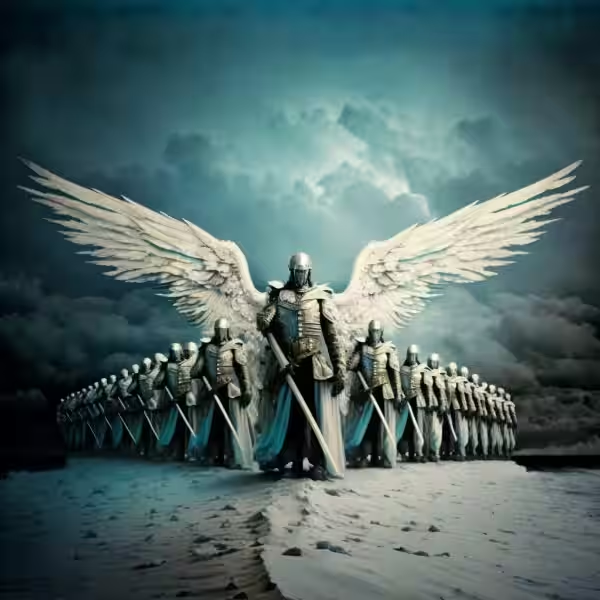
Elisha's prayer, "Open his eyes, Lord, so that he may see," is crucial. God responded by granting the servant spiritual sight. Suddenly, the servant beheld a magnificent sight: a vast bible army of angels, depicted as horses and chariots of fire, completely surrounding them on the hills. This invisible army—a powerful testament to divine protection—became visible only through spiritual eyes, highlighting the existence of a spiritual realm actively involved in earthly affairs.
Following the revelation of the angelic host, Elisha strategically used this divine protection. He prayed for the Syrian army to be struck with blindness, neutralizing their immediate threat. This act wasn't malicious; it was a tactical maneuver to protect himself and his servant. Elisha then led the blinded soldiers to Samaria, the Israelite capital, where their sight was miraculously restored. Instead of retribution, Elisha and the king of Israel showed remarkable mercy, hosting a feast for their former enemies. This unexpected act of compassion led to a lasting peace between Israel and Aram, demonstrating the far-reaching consequences of faith and divine intervention.
Jehovah Sabaoth: The Lord of Hosts and His Angelic Armies
The story of Elisha underscores the biblical concept of God as Jehovah Sabaoth, or the Lord of Hosts—the God of the Angel Armies. This title emphasizes God's role not just as creator and benevolent deity, but also as the powerful commander of celestial forces. This isn't a mere metaphor; scripture consistently portrays God's angelic armies as actively engaged in His work.
Several biblical examples illustrate this point: David's victory over Goliath, for instance, is frequently cited as an example of divine assistance through God’s angelic armies. Similarly, numerous other passages detail angelic interventions, reinforcing the idea of a spiritual realm actively involved in earthly events. The vast number of angels mentioned in Revelation 5:11 further emphasizes the overwhelming power available to believers.
The Unseen Battle and Our Role
While we often focus on the visible world, a greater spiritual conflict rages unseen. God's angelic armies are actively participating in this conflict, fighting on behalf of those who remain faithful. This doesn't mean a passive role for believers; faith necessitates active participation in God’s kingdom through righteous actions. Despite the overwhelming nature of the spiritual battle, the unwavering support of the heavenly host provides reassurance and strength.
A Latter-day Saint Perspective: The Cosmic Struggle
The question of why God uses an army of angels often arises. Within the Latter-day Saint (LDS) perspective, this question receives a nuanced answer. The "war" isn't merely a temporal conflict, but a cosmic struggle dating back to pre-mortal existence.
LDS scripture, particularly Abraham 3:22-28 and Moses 4:1-3, detail a pre-earth council where God presented His plan for the creation of Earth and the testing of spirits' agency. Those who chose to follow God maintained their "first estate" and would receive exaltation. However, Lucifer rebelled, desiring dominion and taking many with him. This rebellion established a fundamental division, with the angels representing both those who followed God and those who followed Lucifer. The angels, therefore, are not separate entities but pre-existent spirits, including ourselves.
This perspective reframes the question. God doesn't employ an external army; the angels are part of the same spiritual family, having chosen sides before mortal life. The "war" is a continuing struggle between good and evil, played out both in heaven and on Earth—a battle we participate in, having chosen sides long ago. This emphasizes God's sovereignty while maintaining the importance of human agency in this ongoing spiritual conflict. The "bible army of angels," then, represents not just a divine force, but also our own spiritual heritage and the active participation of those who chose God before mortal life.
Frequently Asked Questions: The Bible and Armies of Angels
What is the biblical evidence for armies of angels?
The Bible frequently mentions angels, often in large numbers, implying the existence of angelic armies. A powerful example is found in 2 Kings 6:8-23, where the prophet Elisha and his servant are surrounded by the Syrian army. Elisha's servant sees only the overwhelming human threat, but Elisha assures him that God's protective angelic force is even greater. God then grants the servant spiritual sight, revealing a vast army of fiery chariots and horses surrounding them. This visually demonstrates the presence of a powerful, unseen angelic army actively engaged in earthly affairs. The sheer number of angels mentioned in Revelation 5:11 further reinforces this concept of a massive angelic host. Other passages, such as 2 Kings 19:35, illustrate the impact of individual angelic intervention, highlighting the immense power residing within God's celestial army. The title "Jehovah Sabaoth," meaning "Lord of Hosts," emphasizes God's role as commander of these celestial forces.
How do these angelic armies participate in earthly events?
The biblical narrative suggests that angelic armies participate in earthly events in various ways. In the story of Elisha, the angels provide direct protection, surrounding the prophet and his servant, rendering them safe from the Syrian army. They act as a shield against earthly threats, representing God's active involvement in human affairs. In other instances, angels might influence events indirectly, perhaps guiding individuals, inspiring action, or even directly intervening in battles, as seen in the narrative of David and Goliath. The nature of their participation remains somewhat mysterious, but their involvement underscores the ongoing spiritual battle between good and evil, with God's angelic forces actively supporting those who align themselves with Him.
Why does God use an army of angels to combat evil, rather than acting alone?
Some interpretations suggest that the use of angelic armies reflects God's desire to involve other spiritual beings in the cosmic struggle between good and evil. This participation isn't simply a matter of efficiency but a demonstration of divine strategy. It reflects a wider theological understanding of the spiritual world actively engaged with human history. Using angelic forces allows God to work through His created beings, showcasing the collaborative nature of the divine plan. It underscores the concept of a spiritual battle fought both in the heavens and on Earth, a battle in which humanity plays an active role. Different theological perspectives may offer further nuance to this understanding.
What is the significance of the "Lord of Hosts" title?
The title "Jehovah Sabaoth" (Lord of Hosts) signifies God's role as the commander of celestial armies. This title emphasizes not only God's power and authority but also his active involvement in earthly affairs through His angelic forces. It highlights the idea that God is not a detached deity but a powerful and active participant in the ongoing struggle between good and evil, using his angelic armies to protect his faithful and advance his purposes. This title underscores the reality of a spiritual realm actively engaged alongside the physical world.
How can I understand the interaction between the physical and spiritual realms in these accounts?
The interaction between the physical and spiritual realms as depicted in biblical accounts involving angelic armies is often presented as a complex interplay. While the physical realm is tangible and observable, the spiritual realm remains largely unseen to human perception. However, the Bible indicates that the two realms are interconnected, with events in the spiritual realm having a significant impact on the physical world. The story of Elisha and the Syrian army powerfully illustrates this interaction, showing how an unseen angelic army provides protection, directly impacting the outcome of a physical battle. The accounts are meant to illustrate a reality beyond what our natural senses perceive and to inspire faith in God's active involvement in our lives. The precise mechanics of this interaction remain a mystery, but the overarching message is one of divine power and protection available to those who trust in God.