Commands in the New Testament: More Than Just Love?
Commands in the New Testament: More Than Just Love?
Many Christians believe the New Testament offers a simpler ethical framework than the Old Testament's extensive laws. The common understanding is that grace, embodied in Jesus' teachings, supersedes the detailed regulations of the Old Covenant. This is often summarized as simply loving God and loving your neighbor. But is this a complete picture? A closer examination reveals a far more extensive set of commands in the New Testament, suggesting a more complex and demanding ethical landscape for believers.
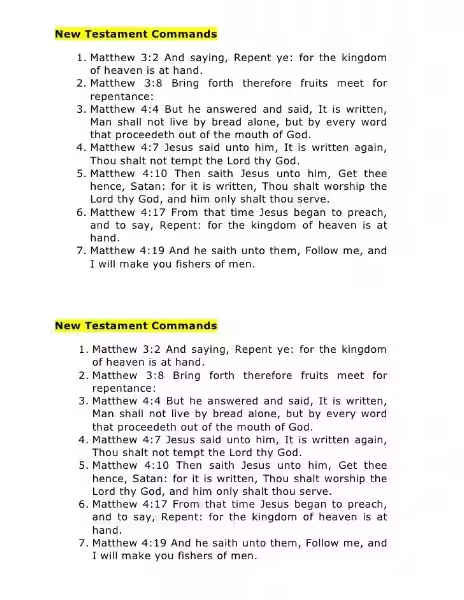
The New Testament, a collection of 27 books, isn't just a narrative of Jesus' life and ministry; it's also a comprehensive guide to Christian living. While the emphasis on grace and love is undeniable, a closer look reveals a surprisingly large number of explicit commands. Some scholars have compiled lists suggesting over 1,050 commands spanning various aspects of life, from personal conduct to interpersonal relationships and community engagement. This vast collection challenges the simplistic notion that Christian ethics boil down to two overarching principles.
These commands aren't arbitrarily scattered; they are systematically interwoven into the narrative and teachings, providing a holistic framework for discipleship. They aren't merely suggestions; they are presented as essential components of a life lived in obedience to God. This implies a deeper level of commitment and engagement than a simple adherence to the "love God and love your neighbor" principle. The sheer volume of directives highlights the comprehensive nature of Christian discipleship. It's not just about having the right feelings; it's about actively engaging in a lifestyle that reflects those feelings in tangible ways.
Categories of New Testament Commands
Understanding the scope of New Testament commands requires examining them thematically. While a precise categorization varies depending on the scholar, several key categories emerge, illustrating the breadth of ethical guidance offered:
A significant portion of New Testament commands focuses on what to avoid. This isn't about legalism; it's about protecting oneself and others from harmful behaviors and influences. Examples include:
Idolatry: The worship of false gods is consistently condemned as a rejection of God's sovereignty.
Immorality: Sexual sins, such as fornication and other forms of sexual misconduct, are explicitly forbidden.
Harmful Substances: The consumption of certain foods, particularly those offered to idols or prepared in ways deemed unclean, is addressed.
These prohibitions aren't arbitrary rules; they are rooted in the understanding that these practices damage our relationship with God and compromise our spiritual well-being. They reflect a concern for holistic health, encompassing physical, emotional, and spiritual aspects.
Commands of Action
Beyond abstinence, the New Testament abounds with commands emphasizing active engagement in faith and life. These commands address various aspects of the Christian experience:
Prayer: The New Testament frequently encourages prayer, not merely as a ritual, but as a vital means of communication with God, seeking His guidance and intervention.
Generosity: Giving to those in need is presented as an essential aspect of Christian discipleship.
Intercession: Praying for others, especially those who have strayed from the faith, is highlighted as an act of love and compassion.
These actions signify a proactive approach to living out one's faith. They are not passive actions but rather intentional steps towards embodying Christian values in daily life. This active engagement is critical for transforming both personal lives and the surrounding community.
Commands of Being
A substantial number of New Testament commands begin with "be," highlighting the importance of character development and inner transformation. Examples include:
Be joyful: Maintaining a positive attitude despite life's challenges.
Be reconciled: Actively seeking restoration in broken relationships.
Be perfect: Striving for holiness and moral excellence.
Be wise, harmless, ready: Cultivating spiritual maturity and preparedness.
These "be" commands emphasize the importance of cultivating virtuous character, reflecting the inner transformation that should accompany faith. They represent a long-term commitment to personal growth and spiritual maturity.
The “Love” Command: Context and Complexity
The often-cited summary of Christian ethics – "love God and love your neighbor" – is not negated by the existence of numerous other commands. Instead, it provides the foundational context within which all other commands are understood. Love becomes the motivating force, the lens through which all other directives are interpreted and applied. The many commands found throughout the New Testament are not merely a list of rules to follow; they are expressions of love in action, ways of showing devotion to God and care for others. They are the practical outworking of a loving relationship with God and neighbor.
Conclusion: A Balanced Perspective
The New Testament presents a rich tapestry of commands, significantly exceeding the simplistic "love God and love your neighbor" summary. However, it's essential to approach these commands with balance and understanding. They are not intended to induce legalism or guilt but to inspire a life of genuine love and devotion. The many commands offer a comprehensive framework for Christian living, guiding believers both in their personal lives and their interactions with the wider world. They are an invitation to a life of faithful obedience, powered by the transformative love of God.
Frequently Asked Questions: Commands in the New Testament
What is the common misconception regarding commands in the New Testament?
A common misunderstanding is that New Testament believers are released from the Old Testament's laws, operating solely under grace. This view often simplifies the New Testament's ethical framework to just "love God and love your neighbor," neglecting the extensive list of commands found within its texts. This interpretation sometimes cites Paul's statement that believers are "not under the law" to justify this minimal approach to obedience.
How many commands are actually found in the New Testament?
A more thorough examination reveals over 1050 commands within the New Testament, significantly exceeding the commonly cited two-commandment summary. These commands are found across various books, including the Gospels and the Epistles of Paul, and cover a broad spectrum of Christian life and behavior.
What are some examples of command categories in the New Testament?
The New Testament commands can be categorized in several ways. Some examples include:
Things to abstain from: This includes actions such as idol worship, fornication, consuming strangled meat or blood, eating meat offered to idols, and engaging in any appearance of evil or fleshly lusts.
Things to avoid: This category encompasses troublemakers, profane talk, false science, unlearned or foolish questions, genealogical disputes, and arguments about the law.
Things to ask for: This speaks to prayer, including asking and receiving, asking for no return of goods (generosity), and asking for life for those who have backslidden (intercession).
Calls to awaken: This encourages spiritual vigilance, urging awakenings to righteousness and to life.
Commands beginning with "be": This vast category includes numerous instructions on behavior and attitudes, such as being joyful, reconciled, perfect, wise, harmless, and ready for Christ's return. These illustrate the breadth of ethical and spiritual instruction within the New Testament.
Does following these commands negate the concept of grace?
No. The extensive nature of New Testament commands doesn't negate the centrality of grace. The principle of grace remains fundamental to the Christian faith. However, it's inaccurate to reduce the New Testament's ethical teaching to a minimal set of commands. Grace motivates obedience, and obedience is a natural response to a loving God. The commands provide a framework for living out a life transformed by grace.
How should we understand the relationship between Old and New Testament commands?
The relationship between Old and New Testament law is complex and debated. While Christians are not bound by the ceremonial laws of the Old Testament (e.g., dietary restrictions, Sabbath observance), the New Testament introduces a new set of commands that reflect the principles of love, righteousness, and holiness. It's more accurate to see a continuity of ethical principles, expressed differently in the context of the new covenant established through Christ.
What is the overall message conveyed by the numerous commands in the New Testament?
The abundant commands in the New Testament present a comprehensive ethical and spiritual framework for Christian living. They encompass all aspects of life, both personal and social, and highlight the importance of obedience, holiness, and love as responses to God's grace. The consequences of disobedience are also addressed, emphasizing the significance of living a life that reflects the teachings of Jesus and the apostles.