Genealogy of Jesus Chart: Unraveling the Mysteries of Jesus' Ancestry
Genealogy of Jesus Chart: Unraveling the Mysteries of Jesus' Ancestry
Understanding the genealogy of Jesus is a complex undertaking, fraught with discrepancies and debated interpretations. The two canonical Gospels, Matthew and Luke, both offer genealogies, but they differ significantly. This naturally leads to questions about their accuracy and what they might truly reveal about Jesus' lineage. This article will explore these differences, examine proposed reconciliations, and delve into some of the intriguing, albeit often speculative, connections proposed by various scholars and researchers.
Reconciling the Discrepant Genealogies of Matthew and Luke
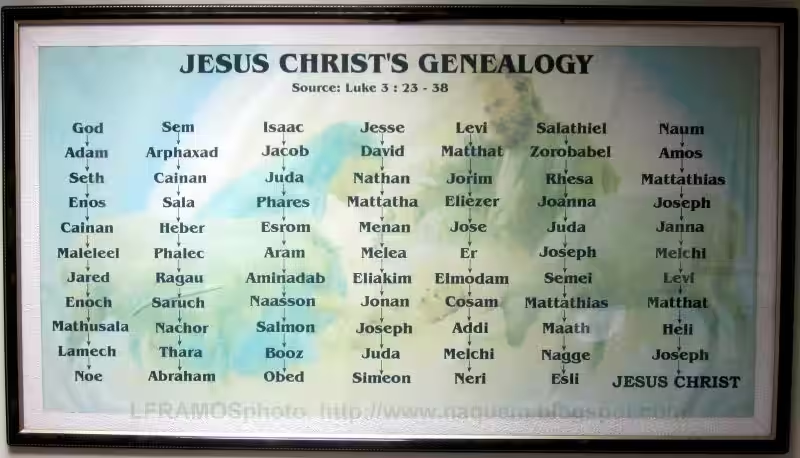
The most immediate challenge in constructing a "genealogy of Jesus chart" lies in the conflicting accounts presented in Matthew 1:1-17 and Luke 3:23-38. Matthew traces Jesus' lineage through Joseph, his legal father, while Luke's genealogy is less clear, potentially tracing through Mary, his mother.
Many scholars have attempted to reconcile these differences. One popular theory suggests that Matthew's genealogy focuses on the legal lineage through Joseph, emphasizing his Davidic descent, a crucial aspect of Jewish messianic expectation. Luke's genealogy, on the other hand, might present Mary's lineage, highlighting a different perspective or set of ancestral connections. This theory, in itself, offers a possible framework to understand the differences between the two genealogies.
This interpretation effectively addresses the immediate conflict between the two gospel accounts. However, it doesn’t fully resolve all the perceived discrepancies.
Heli, Joachim, and the Missing Link: A Proposed Reconciliation
A more nuanced interpretation, drawing on the work of early Christian writers like Sextus Julius Africanus (as quoted by Eusebius), proposes a compelling solution. This theory identifies Heli, mentioned in Luke's genealogy, not as Mary's father, but as Joseph's father-in-law.
This theory suggests that Heli (or Joachim, often identified as the same person) was married to Anna, Mary's mother. Furthermore, the theory posits that Heli’s father, Matthan, had a son, Jacob, who later married Mary's mother, Anna. This scenario would explain why Heli is listed in Luke's account and why Matthew's genealogy doesn't include him. The theory, therefore, attempts to weave these names together and address the apparent discrepancy in a cohesive way. The theory, however, relies on extra-biblical sources, requiring careful consideration of their reliability.
This intricate web of connections requires careful examination of historical sources and their interpretations. The inherent uncertainties of relying on extra-biblical sources must always be kept in mind.
Beyond the Official Genealogies: Speculative Connections and Unproven Claims
Beyond the relatively well-established (though still debated) genealogies of Matthew and Luke, many other speculations have emerged. These often explore potential connections between Jesus and other prominent figures in the Bible, relying on a mix of biblical interpretations, extra-biblical traditions, and sometimes, sheer conjecture. Many of these connections, it is important to note, are not supported by mainstream biblical scholarship.
Mary Magdalene and the Question of Jesus' Marital Status
One such intriguing speculation involves Mary Magdalene's possible relationship with Jesus. Some interpretations posit a marital bond between them, basing this claim on several factors, including the roles women played in ancient Jewish burial practices and the curious silence of Paul (a strong advocate for celibacy) on Jesus' marital status.
It’s crucial to approach these claims critically. Evidence for a marital relationship between Jesus and Mary Magdalene is primarily based on interpretations of biblical texts and extra-biblical sources, many of which are considered unreliable by mainstream scholars. While the absence of evidence is not evidence of absence, the lack of concrete and reliable historical support for this claim makes it a highly speculative idea.
The claim of a marital relationship between Jesus and Mary Magdalene remains a topic of intense debate and requires a careful evaluation of the evidence presented.
Mary Magdalene and Her Family: A Network of Connections
Further expanding on the Mary Magdalene theory, some researchers attempt to connect her to other figures in the Gospels, such as Lazarus, Martha, Simon the Leper, and even Judas Iscariot. These connections are often based on interpretations of biblical passages and references to extra-biblical sources like the Golden Legend.
It's vital to acknowledge the unreliable nature of some of the sources used to support these connections. The Golden Legend, for instance, while a valuable historical text, contains legendary elements that should not be taken as historical fact. Therefore, any claims about the family ties of Mary Magdalene should be approached with considerable caution.
The proposed connections between Mary Magdalene and other biblical figures are largely speculative and require careful scrutiny before acceptance.
Exploring the Ancestry of Mary's Parents: Anne and Joachim
The research into Jesus' genealogy also extends to the lineage of his mother, Mary. Speculations about the family tree of Anne and Joachim, Mary's parents, often draw on a variety of sources, including the Golden Legend and even contributions from online forums.
These attempts to trace back the ancestry of Jesus' mother are often based on fragmented and unreliable sources. They should be viewed as intriguing possibilities, but not as conclusively established historical facts. The lack of substantial primary sources makes it difficult to verify these claims.
Constructing Your Own Genealogy of Jesus Chart: A Word of Caution
While constructing a "genealogy of Jesus chart" can be a fascinating intellectual exercise, it's essential to approach it with critical awareness. Remember that many of the proposed connections are based on speculation and interpretation of often contradictory sources. A responsible approach involves acknowledging the limitations of the available evidence and avoiding the temptation to jump to conclusions. Using multiple sources, while helpful, requires careful evaluation of each source's reliability and potential biases. Always distinguish between historical fact, interpretations, and speculation. The goal is not to create a definitive chart, but to understand the complexities and uncertainties inherent in reconstructing Jesus' ancestry.
What is a Genealogy of Jesus Chart?
A Genealogy of Jesus chart attempts to visually represent the family tree of Jesus Christ, tracing his ancestry back through several generations. However, it's important to note that creating a definitive chart is challenging due to discrepancies and gaps in the biblical accounts themselves. Different charts exist, reflecting various interpretations and uses of available historical and religious sources.
Why are there differences between Matthew and Luke's genealogies of Jesus?
The Gospels of Matthew and Luke both provide genealogies of Jesus, but they differ significantly. One common interpretation is that Matthew traces the lineage through Joseph, Jesus' legal father, while Luke traces the lineage through Mary, Jesus' mother. This explains the differing names and ancestral lines presented in each Gospel. Other theories exist, but the dual lineage theory is a prominent attempt to reconcile the differences.
How does the chart reconcile the discrepancies between Matthew and Luke?
Some proposed charts attempt reconciliation by suggesting that the seemingly contradictory lineages represent separate lines of descent—Joseph's patriarchal lineage (Matthew) and Mary's matriarchal lineage (Luke). This often involves reinterpreting names and relationships within the biblical text and incorporating extra-biblical sources, which are always treated with caution due to the lack of definitive proof.
What extra-biblical sources are used in some interpretations of Jesus' genealogy?
Various extra-biblical sources have been considered in constructing genealogical charts of Jesus. These include the writings of Sextus Julius Africanus (as quoted by Eusebius), the Golden Legend (acknowledging its legendary nature and unreliability), and even information from online resources like Reddit and websites specializing in biblical research. However, it's crucial to remember that these sources vary greatly in reliability and should be approached with critical evaluation.
Does the chart address Jesus' marital status?
Some interpretations of Jesus' genealogy speculate about his marital status, often suggesting a possible relationship with Mary Magdalene. This speculation is based on interpretations of biblical texts, ancient Jewish burial customs, and the lack of explicit condemnation of marriage in Jesus' teachings. Yet, this remains highly debated and not supported by mainstream Christian theology. It's important to differentiate between scholarly speculation and fictional narratives.
What is the role of Mary Magdalene in some genealogical interpretations?
Some interpretations connect Mary Magdalene to Jesus through family ties, linking her to Lazarus, Martha, Simon the Leper, and even Judas Iscariot. This is primarily based on interpretations of biblical passages and extra-biblical traditions. These connections are highly debated and lack definitive historical proof. It's crucial to distinguish between established historical fact and inferences based on various, sometimes dubious, sources.
How reliable are the sources used in creating these charts?
The reliability of sources used in creating these charts varies considerably. Biblical texts themselves contain inconsistencies. Extra-biblical sources, like the Golden Legend or various online forums, range from being reasonably well-researched to being wholly speculative. The interpretation and weight given to these different sources significantly influence the resulting genealogical chart, leading to diverse and often conflicting conclusions. Any chart should clearly state its sources and their respective limitations.
Should I trust a single Genealogy of Jesus chart as definitive?
No. Due to the inherent difficulties in constructing a complete and accurate genealogy of Jesus, based on sometimes conflicting and incomplete sources, no single chart should be considered definitive. Readers should always approach such charts with a critical eye, considering the sources used, the interpretations made, and the limitations of the available evidence. Multiple perspectives and scholarly discussions should be consulted before drawing conclusions.