Is Everyone Descended from the 12 Tribes of Israel?
Is Everyone Descended from the 12 Tribes of Israel?
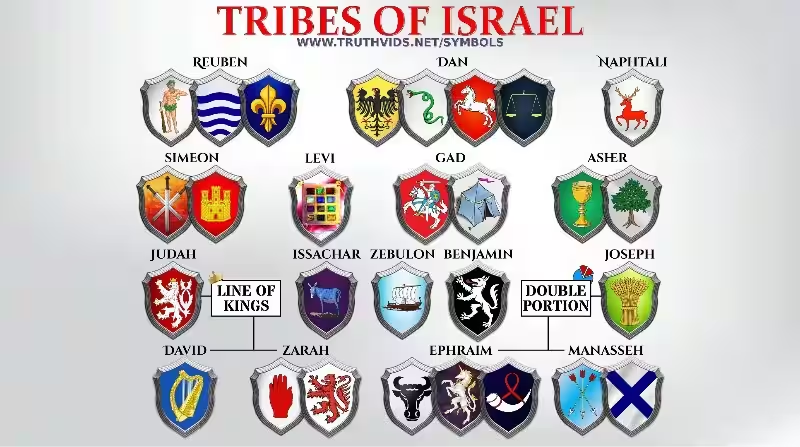
The question of whether everyone is descended from the 12 tribes of Israel is a complex one, sparking debate across religious, historical, and scientific disciplines. While some religious interpretations suggest a universal connection, genetic and historical evidence paints a more intricate picture. This article explores the diverse perspectives surrounding this intriguing question, focusing on the modern implications for Jewish identity and community.
The concept of "lost tribes" significantly complicates the issue. The ten tribes of Israel, exiled by the Assyrians, disappeared from historical records, leaving behind a legacy of speculation about their descendants. This mystery has fueled the search for potential descendants across the globe, leading to significant implications for the modern Jewish community.
The assertion that everyone is descended from the twelve tribes often stems from a literal interpretation of Biblical texts. However, this interpretation is challenged by both genetic and historical evidence. The sheer scale of human migration and intermingling across millennia makes such a universal claim improbable. Furthermore, the concept of "tribe" itself is fluid and difficult to define across vast historical spans.
Defining “Lost” Jews: Three Key Categories
Rabbi Eliahu Birnbaum offers a helpful framework for understanding the complexities of identifying potential descendants. He proposes categorizing potential descendants into three groups:
Nidchei Yisrael (Spiritual Descendants): Individuals who, regardless of lineage, deeply connect with Jewish spirituality and practice. This group emphasizes a commitment to Torah and mitzvot (commandments) as the defining characteristic of Jewish identity.
Zera Yisrael (Patrilineal Descendants): Those who claim a direct male lineage tracing back to the twelve tribes. This category highlights the traditional emphasis on patrilineal descent in Jewish law.
Giyorim (Converts): Individuals who have formally converted to Judaism through the halakhic (Jewish legal) process. This group represents the formally recognized pathway to Jewish affiliation, regardless of ancestry.
Birnbaum argues that a rigid, bloodline-based approach is insufficient. Instead, he emphasizes the importance of spiritual connection and commitment to Jewish practice as defining characteristics of Jewish identity. He advocates for a shift from asking "Who is a Jew?" to "What is the Jewish nation?", positioning conversion as a pathway to formal inclusion.
The Case of the Igbo People and Other Communities
The Igbo community in Nigeria, claiming descent from the tribe of Gad, exemplifies the challenges and complexities involved. While some emphasize genetic studies and shared cultural practices to support their claims, others suggest a more gradual approach.
Hakham Yehonatan Elazar-DeMota proposes a return to traditional Igbo religion, omenana, before formal conversion, pending the reestablishment of a Sanhedrin (an ancient Jewish court). This approach prioritizes a process of rediscovering and reclaiming their ancestral heritage before engaging in formal conversion. Conversely, Nathaniel Shmayah Nwamini, a Torah-observant Igbo, advocates for immediate Orthodox conversion to solidify their Jewish identity and address the lack of Jewish education within their community. This highlights the diverse viewpoints within the Igbo community itself, reflecting the spectrum of opinions on the path to Jewish integration.
Similar discussions are occurring with other groups around the world, each presenting unique cultural and historical contexts influencing their approach to Jewish identification and inclusion.
The Role of Halakhic Conversion and Social Challenges
Dr. Ari Greenspan highlights the significant increase in individuals converting to Judaism in recent years, partly attributed to missionary efforts and the accessibility of online resources ("YouTube Judaism"). He emphasizes that, regardless of lineage claims, halakhic conversion remains the necessary pathway for mainstream acceptance within the Jewish community.
However, Greenspan also points out the significant social challenges facing non-Ashkenazi converts, highlighting existing prejudices within the Jewish community that need addressing. This necessitates a more inclusive and welcoming approach to integrating diverse groups into the broader Jewish community.
Yaffah Batya deCosta, CEO of Ezra L’Anousim, focuses on the challenges faced by crypto-Jews (Bnei Anasim)—those who secretly practiced Judaism due to persecution. She advocates for a process of giyur lechumra (return certificate) for those with demonstrable matrilineal Jewish ancestry, emphasizing the need to acknowledge their unique historical circumstances.
DeCosta stresses the significant obstacles these individuals face, particularly in accessing Israel through aliyah (immigration to Israel) due to discriminatory practices within certain Jewish communities. This underscores the need for a more comprehensive and equitable approach to integrating these overlooked members of the Jewish family.
The Importance of a Torah-Centered Life and the Bnei Menashe Example
David Breakstone emphasizes the centrality of a Torah-centered life, arguing that conversion, even for those with demonstrable ancestry, is essential for full integration within the Jewish community. He believes the potential contributions of these communities outweigh concerns about mass immigration unrelated to genuine Jewish identity.
The Bnei Menashe community from India and Burma provides a successful model for integration. Their inclusion, facilitated by Rabbi Eliyahu Avichail and Shavei Israel, involved thorough vetting, individual conversions, and ultimate acceptance into Israeli society. This highlights the possibility of successful integration when a structured and supportive process is implemented.
The Need for a Comprehensive Approach
In conclusion, the question of whether everyone is descended from the 12 tribes of Israel is best considered through a nuanced lens. While some may hold to a literal interpretation, a more accurate understanding involves evaluating the historical, genetic, and religious considerations.
A comprehensive approach, perhaps involving a Knesset committee, is needed to develop case-by-case solutions. This approach should prioritize individual conversion while acknowledging the unique histories and traditions of each group, addressing social and political complexities to ensure a fair and inclusive process for all. Ultimately, the goal is to strike a balance between halakhic observance and the spiritual connection to Judaism, fostering a welcoming and inclusive Jewish community that values both tradition and the diversity of its members.
Frequently Asked Questions: Descent from the Twelve Tribes of Israel
Are all people descended from the twelve tribes of Israel?
No, the assertion that all people are descended from the twelve tribes of Israel is not supported by current genetic, historical, or archaeological evidence. While the biblical narrative describes the lineage of Jacob (Israel) and his twelve sons, this account is considered by many to be a mythological narrative rather than a literal historical record. Modern genetic studies reveal a far more complex tapestry of human migration and intermingling, demonstrating a far greater diversity of human ancestry than could be traced back to a single ancestral group. Historical records also show the independent development of numerous cultures and civilizations across the globe, inconsistent with the idea of universal descent from a single source.
What about the biblical account of Jacob's twelve sons?
The biblical account of Jacob's twelve sons is a foundational narrative in Judaism, Christianity, and Islam. However, it's crucial to differentiate between religious belief and historical fact. While the story holds profound religious significance for many, it lacks the detailed genealogical information and archaeological evidence needed to support a claim of universal descent from these twelve tribes. The narrative should be understood within its religious and cultural context, not as a literal historical account of global ancestry.
Do genetic studies support the idea of universal descent from the twelve tribes?
No, genetic studies strongly contradict the idea of universal descent from the twelve tribes. Modern genetics demonstrates a complex and diverse human lineage spanning millennia and continents. While genetic markers may show shared ancestry among certain populations, tracing all global populations back to the twelve tribes is unsupported by current scientific understanding of human genetic diversity.
What is the significance of claims of tribal descent by various communities today?
Many communities around the world claim descent from one or more of the "lost tribes" of Israel. These claims often involve a combination of oral traditions, cultural practices, and sometimes genetic studies. However, the process of integrating these communities into the existing Jewish community is complex and involves navigating halakhic (Jewish law) requirements, historical considerations, and the social and political realities of modern Judaism. For formal inclusion in the Jewish community, conversion according to Jewish law (Halakha) is generally required, regardless of claims of ancestral lineage.
How does the Jewish community address claims of descent from the lost tribes?
The Jewish community's response to claims of descent from the lost tribes varies. Some emphasize the importance of halakhic conversion as the primary path to Jewish identity, regardless of ancestral claims. Others consider spiritual connection to Judaism and commitment to Jewish practices as significant factors. There is currently no universally accepted method for determining who is a descendant of the lost tribes, and different groups and individuals hold varying perspectives on this issue. This complexity has led to ongoing discussions and debates within the Jewish community. Successful integration, as seen with the Bnei Menashe community, is often achieved through a thorough vetting process, individual conversions, and community acceptance.
Is there a single, universally accepted definition of "Jew" in this context?
No, there is no single, universally accepted definition of "Jew" within the context of claims of descent from the lost tribes. The definition depends heavily on the perspective: halakhic (Jewish law), historical, genealogical, or spiritual. This lack of a universally agreed-upon definition contributes to the complexities involved in integrating communities claiming Israelite descent. The question is further complicated by the varying interpretations of what constitutes a "tribe" and its relevance across vast spans of time and diverse cultures.