What Tribe Was Peter From? Unraveling the Mystery of the Apostle's Lineage
What Tribe Was Peter From? Unraveling the Mystery of the Apostle's Lineage
The question, "What tribe was Peter from?" is one that has intrigued biblical scholars and history enthusiasts for centuries. While the Bible provides glimpses into Peter's life and ministry, pinpointing his precise tribal affiliation proves surprisingly elusive. This article will explore the known facts, the historical context, and the reasons why a definitive answer remains out of reach.
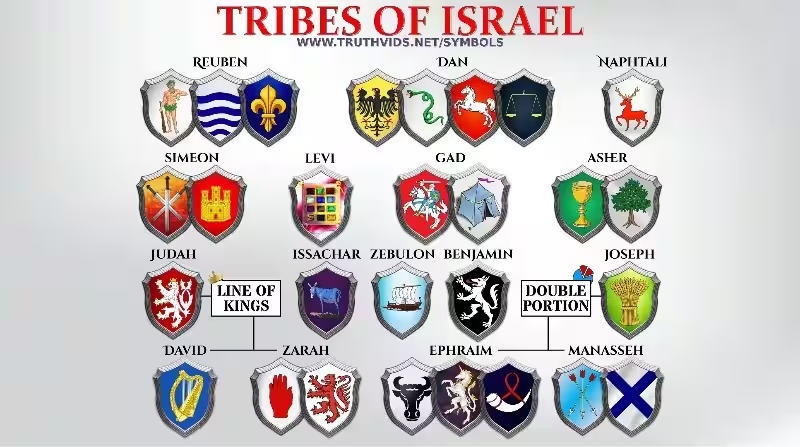
The New Testament offers some geographical clues but remains frustratingly silent on Peter's tribal origins. John 1:44 mentions that Peter, along with Andrew and Philip, hailed from Bethsaida. Bethsaida, a town located on the Sea of Galilee, is generally considered to have been situated within the territory historically assigned to the tribe of Naphtali.
However, this geographical association does not automatically equate to Peter's tribal identity. The biblical narrative itself reveals a degree of fluidity concerning tribal boundaries. Significant population movements and migrations throughout Israel's history blurred the lines between the tribes.
The post-Solomonic period, in particular, witnessed considerable population shifts. The division of the kingdom and subsequent conflicts led to both intentional and forced migrations. This resulted in a substantial blending of populations, making precise tribal identification difficult even for individuals who may have maintained a sense of their ancestral lineage.
The destruction of the Second Temple in 70 AD represents a critical turning point in this investigation. The Temple housed extensive genealogical records, meticulously maintained over centuries. The Temple's destruction resulted in the irretrievable loss of these vital documents, severely hampering any attempts to trace the ancestry of individuals, including Peter, to specific Israelite tribes.
This lack of historical documentation is a significant obstacle. Without access to those meticulously kept records, any assertion about Peter’s tribal affiliation becomes purely conjectural. While Bethsaida provides a geographical reference point, it doesn't offer conclusive evidence regarding his tribe.
The Significance of James' Epistle
James, in his epistle, addresses the "twelve tribes scattered abroad" (James 1:1). This verse underscores the significant dispersal and intermingling of the Israelite tribes. The phrase highlights that the concept of tribal identity, while still meaningful, was not strictly defined by geographical location. Individuals maintained a sense of belonging to their ancestral tribes, but these affiliations were not necessarily tied to specific geographical regions. This reinforces the idea that knowing Peter came from Bethsaida doesn’t answer the question of what tribe was Peter from.
Why a Definite Answer Remains Elusive
In summary, the question of Peter's tribal origin remains unanswered due to a combination of factors:
Limited Biblical Information: The Bible provides geographical information but lacks explicit details regarding Peter's tribal lineage.
Fluid Tribal Boundaries: Historical population movements and migrations blurred the lines between tribes, making precise identification difficult.
Loss of Genealogical Records: The destruction of the Second Temple resulted in the loss of crucial genealogical records, making it impossible to trace Peter's lineage with certainty.
Therefore, any attempt to definitively answer "What tribe was Peter from?" based on current evidence would be purely speculative. While his association with Bethsaida provides a valuable geographical context, it does not offer definitive proof of his tribal identity. The historical complexities surrounding tribal movements and the destruction of key genealogical records render a conclusive determination currently unattainable.
Speculation vs. Fact
It's important to distinguish between speculation and established fact. While many might speculate based on Bethsaida's location within Naphtali territory, linking Peter to that tribe is inherently an assumption rather than a demonstrable truth. It is crucial to maintain intellectual honesty regarding what we can and cannot know with certainty based on the available historical evidence. Focusing on Peter's faith, ministry, and impact on early Christianity is far more fruitful than engaging in unproductive speculation about his tribal origins.
Focusing on What Matters
Ultimately, the enduring legacy of the Apostle Peter rests not on his tribal affiliation but on his unwavering faith, his courageous witness, and his pivotal role in the establishment of the early Christian church. His impact on Christianity transcends the question of his tribal origins. His life and ministry offer profound lessons in faith, commitment, and forgiveness that continue to inspire believers today, regardless of any uncertainties surrounding his precise ancestral roots. Perhaps, focusing on what truly matters is a more fruitful endeavor than the pursuit of an elusive answer to a question that may forever remain unanswered.
What tribe was Peter from?
The Bible doesn't explicitly state which tribe Peter belonged to. While John 1:44 mentions that he, Andrew, and Philip were from Bethsaida, a city in the territory associated with the tribe of Naphtali, this isn't conclusive proof. Significant population movements and intermingling of tribes throughout Israelite history make definitively tracing his lineage impossible. The destruction of the Temple in 70 AD further complicates matters by eliminating key genealogical records. Therefore, any claim about Peter's tribal affiliation would be purely speculative.
Was Peter's hometown relevant to his tribal origin?
His hometown of Bethsaida, located in the region historically associated with Naphtali, provides geographical context but doesn't confirm his tribal identity. Tribal boundaries were fluid, and considerable population shifts throughout Israelite history resulted in significant intermingling of the tribes. Therefore, even knowing his hometown doesn't definitively determine his tribal lineage.
No definitive evidence exists to determine Peter's tribal affiliation. The lack of explicit biblical mention coupled with the historical realities of population movements and the loss of genealogical records makes it impossible to definitively answer this question. Any attempt to assign him to a specific tribe would be conjecture.
Why is it difficult to determine Peter's tribe?
Determining Peter's tribe is difficult due to a combination of factors: the biblical text doesn't directly state his tribe, significant population migrations blurred tribal lines, and the destruction of the Temple in 70 AD resulted in the loss of genealogical records crucial for tracing ancestry. These historical complexities prevent a conclusive determination.
Could future discoveries change our understanding?
While unlikely, future archaeological discoveries or the uncovering of previously unknown historical texts could potentially shed light on Peter's tribal affiliation. However, based on currently available evidence, it remains impossible to definitively answer this question.