What Did Apostle Paul Look Like? Unraveling the Mystery
What Did Apostle Paul Look Like? Unraveling the Mystery
The Apostle Paul, a pivotal figure in early Christianity, left an indelible mark on the world through his teachings and writings. However, what did Apostle Paul look like? This question, surprisingly, remains unanswered. While we have a wealth of information regarding his theological contributions and missionary journeys, concrete details about his physical appearance are remarkably scarce. This article explores the limited textual evidence, the influence of apocryphal texts, and the deeper theological implications of this lack of description.
The Biblical Silence and the Emphasis on Inner Qualities
The canonical texts of the New Testament, including the Acts of the Apostles and Paul's epistles, provide surprisingly little information on Paul’s physical appearance. Unlike some Old Testament figures, whose physical attributes are occasionally mentioned (think of David's handsomeness or Samson's strength), Paul's physical characteristics are largely absent.
This omission isn't accidental. The New Testament consistently prioritizes inner qualities over outward appearances. The focus is repeatedly placed on the heart – the center of one's spiritual, emotional, and moral life. Jesus's teachings, particularly the Beatitudes, emphasize the importance of inner purity and righteousness. This theological emphasis helps explain the lack of detailed physical descriptions of key figures, including Jesus himself and the twelve disciples.
This emphasis on inner transformation is further exemplified in King David's prayer for a clean heart, reflecting a deeper concern with spiritual purity rather than physical perfection. The Bible's consistent focus directs our attention to the transformation of the soul rather than the superficial aspects of physicality.
The Apocryphal “Acts of Paul and Thecla”: A Contested Source
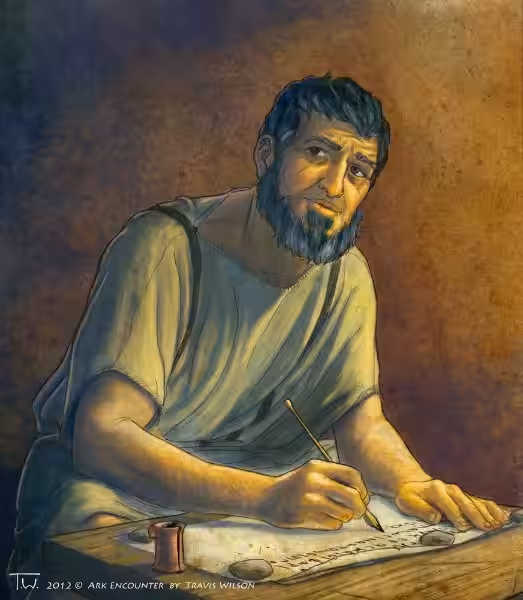
The apocryphal "Acts of Paul and Thecla," a second-century text not included in the New Testament canon, offers a detailed description of Paul's physical appearance. This text, while not considered historically reliable by the majority of scholars, provides a potential answer to the question, "What did Apostle Paul look like?".
According to this account, Paul is depicted as a short, bald, bow-legged man. However, the text also notes his "well-built" physique and, notably, that his presence sometimes appeared angelic, suggesting a perceived divine aura. This intriguing description, while interesting, must be viewed with caution given the apocryphal nature of the source.
The "Acts of Paul and Thecla" description significantly influenced medieval artistic representations of Paul. Many depictions from this period reflect elements from this apocryphal text, highlighting the lasting impact – even if inaccurate – of this non-canonical source. However, it's crucial to remember that artistic license often overshadows historical accuracy.
Reconciling Fiction and Potential Truth
The challenge lies in discerning the possible factual elements within a largely fictional narrative. It's possible that some details within the "Acts of Paul and Thecla" – perhaps the short stature or stocky build – might have some basis in reality. However, the angelic transformations and other fantastical elements clearly fall outside the realm of historical accuracy.
This highlights the complexity of historical interpretation, particularly when dealing with religious texts. It underscores the need for critical analysis and a careful discernment between factual claims and embellished narratives. The "what did Apostle Paul look like" question requires a nuanced approach, acknowledging both the limitations of the available sources and the possibility that some details, however fragmented, might carry a kernel of truth.
Clues from the Canonical Texts: A Less-Than-Ideal Image
While the Bible doesn't offer a physical portrait, certain passages might indirectly suggest aspects of Paul's appearance. In 2 Corinthians 10:10, Paul himself acknowledges criticisms about his physical presence, contrasting it with the powerful impact of his written words. This suggests that he might not have been a particularly charismatic orator, potentially possessing an unassuming, even unremarkable, demeanor.
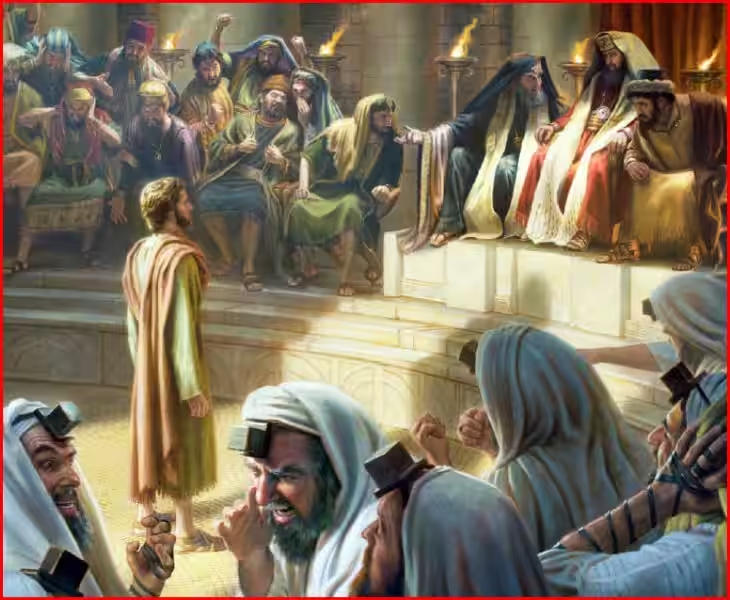
Moreover, several accounts allude to significant physical injuries sustained during his missionary journeys. The brutal stoning described in Acts 14 undoubtedly left him severely wounded, possibly with lasting physical damage. This might have included broken bones, scars, and possibly even a head injury. His later recuperation in Derbe hints at the lingering effects of this trauma.
Further suggesting a physically marked individual, Galatians 6:17 mentions "the marks of Jesus" on his body, clearly referring to the scars and wounds accumulated throughout his ministry. This imagery paints a vivid picture of a man deeply marked by his experiences, his physical appearance a testament to the hardships endured for his faith.
A Physically Unremarkable Apostle?
Combining this evidence with the description in the "Acts of Paul and Thecla," a picture emerges of a physically unremarkable, perhaps even unprepossessing, individual. This image stands in stark contrast to modern expectations of a charismatic religious leader. Instead of physical attractiveness, Paul’s appearance may have been a reflection of the suffering and dedication involved in his ministry.
In conclusion, the question of "what did Apostle Paul look like" ultimately remains unanswered. While the apocryphal "Acts of Paul and Thecla" offers a detailed (though questionable) description, the canonical texts remain silent. However, this absence of physical description is arguably deliberate, highlighting the New Testament's emphasis on inner qualities over outward appearances. Perhaps the most accurate image of Paul is one of a man profoundly marked by his faith, whose physical appearance, whatever it may have been, was secondary to the transformative power of his message.
What Did the Apostle Paul Look Like?
This is a question that has intrigued people for centuries, and unfortunately, one that we cannot definitively answer. The Bible itself offers no detailed description of Paul's physical appearance. Any attempts to reconstruct his looks must rely on limited and often unreliable sources.
What physical descriptions of Paul exist?
The most detailed description comes from the non-canonical Acts of Paul and Thecla, a second-century text. This account depicts Paul as short, bald, bow-legged, but with a strong build. It also mentions joined eyebrows and a long nose. However, the Acts of Paul and Thecla is considered apocryphal (not part of the officially accepted biblical canon) and its historical accuracy is debated. While some elements might be based on real details, the overall narrative is largely fictional, making this description unreliable.
Are there any other clues in the Bible regarding his appearance?
The canonical New Testament doesn't provide a physical portrait of Paul. While certain biblical figures have physical descriptions (e.g., Absalom's hair), this is the exception, not the rule. The New Testament prioritizes Paul's actions, teachings, and spiritual journey over his physical attributes.
Did Paul suffer any physical injuries?
The accounts in the Acts of the Apostles mention a stoning that left Paul seemingly dead. This suggests he may have sustained severe and lasting injuries, such as broken bones, cuts, bruises, or even head trauma. Galatians 6:17 refers to "the marks of Jesus" on Paul's body, likely scars from his ministry. This points to a man bearing significant physical damage, which would have profoundly impacted his appearance.
So, what can we reasonably conclude about Paul's appearance?
Based on the limited information, we can speculate that Paul was likely unremarkable in appearance. The apocryphal description, despite its dubious origins, aligns with the image portrayed in the New Testament: a man whose physical presence wasn't a source of immediate charisma. His powerful message contrasted with a possibly unassuming, even physically damaged, exterior. The emphasis in the Bible is on his inner qualities, his faith, and his impact on early Christianity, not his physical attractiveness. Therefore, any attempt at a visual reconstruction will remain largely speculative.
Why is there so little emphasis on physical appearance in the Bible?
The Bible, particularly the New Testament, consistently prioritizes inner qualities (faith, love, compassion) over outward appearance. The focus is on spiritual transformation and the "heart," reflecting a theological perspective that values spiritual development above physical aesthetics. This emphasis on inner qualities is a major reason why detailed physical descriptions of biblical figures are rare.