What Did Paul Look Like? Unraveling the Mystery of the Apostle's Appearance
What Did Paul Look Like? Unraveling the Mystery of the Apostle's Appearance
The Apostle Paul, a pivotal figure in the early Christian church, remains shrouded in mystery when it comes to his physical appearance. Despite the extensive record of his life and teachings across 15 chapters of Acts and 13 epistles attributed to him, a contemporary description of what he looked like is conspicuously absent from the canonical New Testament. This lack of detail naturally leads to much speculation and questions.
The Only Detailed Description: A Non-Canonical Source
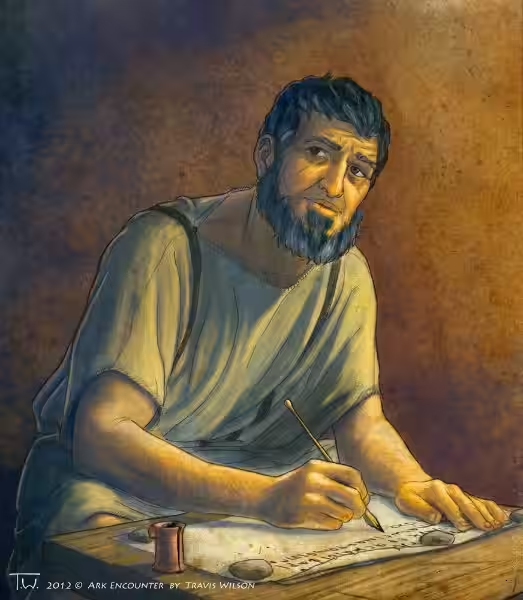
The most detailed description of Paul's appearance comes from a non-canonical source, the Acts of Paul and Thecla, dating back to the mid-second century. This text, considered apocryphal by most modern scholars, paints a picture of a man of relatively short stature, bald, bow-legged, with a well-built physique. It further adds that he had prominent eyebrows that met in the middle, a rather long nose, and a countenance described as shifting between human and angelic.
This description, however, is not without its controversies. Its origin in a text not considered part of the Bible's accepted canon raises immediate questions about its accuracy. Was it based on genuine oral tradition passed down through the generations? Or is it purely fictional embellishment added to an already fantastical narrative? The lack of corroborating evidence from other historical sources leaves the question unanswered.
The Significance of the Description in Acts of Paul and Thecla
Despite the uncertainty surrounding the accuracy of the Acts of Paul and Thecla's description, it's noteworthy for its historical influence. Medieval artists frequently referenced this description when depicting Paul, showcasing its impact on the visual representations of this influential figure.
This highlights a crucial point: even if the description isn't perfectly accurate, it demonstrates how important the question of "what did Paul look like?" has been throughout history. The need to visualize this significant figure pushed people to rely on the source available to them.
The Absence of Physical Descriptions in the Bible
The lack of physical descriptions for Paul is not unique. The Bible, while rich in narrative detail regarding the lives and actions of its characters, rarely delves into specifics regarding their physical appearance. While certain individuals are described – such as Rebekah's beauty, Absalom's hair, or Zacheus's short stature – these are exceptions rather than the rule.
Even Jesus, the central figure of Christianity, is not physically described in detail. This consistent avoidance of physical descriptions in the biblical text points towards a deliberate focus on something else entirely.
Spiritual Emphasis Over Physical Attributes
The Bible consistently prioritizes inner character over outward appearance. The emphasis is firmly placed on the heart – the seat of spiritual, mental, and emotional life. King David's famous prayer for a clean heart, and Jesus's Beatitudes focusing on purity of heart, exemplify this central theme.
This is not to say that physical appearance is entirely irrelevant. People naturally care about how they present themselves. However, the overarching message is clear: inner qualities of faith, compassion, and piety are far more important than physical attributes.
Reconciling the Description with the Biblical Emphasis
The Acts of Paul and Thecla's description, even if accurate, actually reinforces this biblical emphasis on inner qualities. While the physical features described might not align with modern standards of beauty, the text also emphasizes Paul's overall "full of grace." This highlights the importance of inner qualities like grace and piety, emphasizing that these virtues far outweigh any concern about physical attractiveness.
This understanding is crucial in properly appreciating the legacy of Paul. It's not about his height, build, or hair; it's about the profound impact of his teachings and unwavering faith.
Focusing on Paul's Legacy, Not His Looks
The question of "what did Paul look like?" ultimately leads us to a more profound question: what truly matters about Paul? The answer lies not in his physical features, but in his unwavering dedication to spreading the Christian message, his profound theological insights, and the lasting impact of his writings.
Whether he was tall or short, bald or haired, is ultimately irrelevant. His influence transcends physical descriptions. His legacy is etched in the words he wrote, the lives he touched, and the enduring power of the Gospel he championed. Therefore, while we may never know definitively what Paul looked like, we should focus on his lasting spiritual contributions to Christianity. The real essence of Paul is not in his physical form, but in the powerful message he delivered and the enduring impact he had on the world.
Frequently Asked Questions: What Did the Apostle Paul Look Like?
What is known about the Apostle Paul's physical appearance?
The Apostle Paul's physical appearance is largely unknown. While numerous depictions exist, these are artistic interpretations based on limited information and not supported by contemporary historical records. No description of his physical attributes comes from the canonical New Testament books.
Are there any descriptions of Paul's appearance from historical sources?
The only detailed description comes from the non-canonical Acts of Paul and Thecla, a text dating to the mid-second century. This text describes Paul as "small in size, bald-headed, bow-legged, well built, with eyebrows that met, rather long-nosed and full of grace." However, the accuracy of this description is heavily debated by scholars. The Acts of Paul and Thecla is considered largely fictional, and the description's inclusion within this work doesn't guarantee its veracity. While some scholars believe it may contain elements of truth reflecting oral traditions, there's no definitive proof.
How reliable is the description in Acts of Paul and Thecla?
The reliability of the description found in Acts of Paul and Thecla is questionable. While the text may preserve some elements of oral tradition regarding Paul's appearance, the work itself is generally considered apocryphal and contains significant fictional elements. Its use as a reliable source for Paul's physical characteristics is therefore disputed among scholars. The description's influence on medieval depictions of Paul is notable, but this doesn't validate its accuracy.
Why is there a lack of physical descriptions of biblical figures?
The Bible places significantly more emphasis on inner character and spiritual qualities than on physical attributes. The focus is consistently on the heart – the seat of spiritual, moral, and emotional life. While physical appearances are mentioned occasionally (e.g., Rebekah's beauty, Absalom's hair), these are exceptions. The lack of descriptions for major figures like Jesus and the twelve disciples reflects this overarching priority.
What is the significance of the emphasis on inner qualities over physical appearance?
The emphasis on inner character over physical appearance highlights the Bible's central message about the importance of spiritual transformation and devotion. This contrasts with modern society's focus on outward appearances. Even if a description of Paul's physical features were definitively proven accurate, the emphasis on his "full of grace" in Acts of Paul and Thecla underscores the text's prioritization of inner qualities over physical attractiveness.
In summary, what can we conclude about Paul's appearance?
Ultimately, we cannot definitively say what the Apostle Paul looked like. While a description exists in a non-canonical text, its reliability is questionable. The scarcity of physical descriptions of other biblical figures underscores the prioritized focus on inner character and spiritual transformation found throughout scripture. Any attempt to visualize Paul should remember this focus and avoid overemphasis on potentially inaccurate physical descriptions.