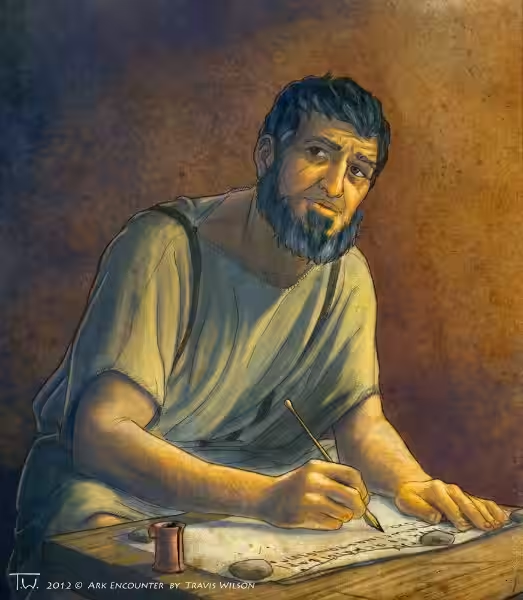
The Apostle Paul, a towering figure in early Christianity, remains shrouded in mystery when it comes to his physical appearance. While his writings profoundly shaped the course of the religion, detailed descriptions of what did the apostle Paul look like are conspicuously absent from the canonical texts of the New Testament. This lack of information has spurred centuries of speculation, artistic interpretation, and scholarly debate.
The most widely circulated description of Paul's physical appearance comes from a non-canonical source: the Acts of Paul and Thecla. Written around the second century AD, this apocryphal text—meaning it's not considered part of the Bible's official canon—offers a rather detailed portrait.
This document paints a picture of Paul as "small in size, bald-headed, bow-legged, well built, with eyebrows that met, rather long-nosed and full of grace." While intriguing, it's crucial to remember the context. The Acts of Paul and Thecla focuses primarily on Thecla's conversion and her rejection of marriage to dedicate her life to Christ. Paul serves as a pivotal figure in her narrative, but the description of his physical attributes is secondary to the central story.
Therefore, the accuracy of this depiction remains highly questionable. It's embedded within a narrative that is largely considered fiction by most biblical scholars. The details, however interesting, could be purely imaginative embellishments to enhance the story's impact.
The scarcity of physical descriptions in the Bible is itself a significant point. While some individuals, like Rebekah's beauty or Absalom's striking looks are mentioned, these are exceptions rather than the rule. More frequently, physical details are functional—such as Zachaeus's short stature or Bartimaeus's blindness—or implied through actions, like John the Baptist's implied agility.
Even Jesus, central to the Christian faith, lacks a detailed physical description. The same holds true for the twelve apostles. This consistent absence suggests a deliberate theological point: the Bible's focus is not on outward appearance but on inner character and spiritual qualities.
The Emphasis on Inner Character
The Bible consistently prioritizes the “heart” – not just the physical organ, but a holistic representation encompassing the spiritual, mental, and emotional aspects of a person. King David's prayer for a "clean heart" perfectly exemplifies this focus on spiritual purity. Jesus himself reinforced this priority when he declared, "blessed are the pure in heart, for they will see God."
This emphasis on inner character is pivotal in understanding why detailed physical descriptions are largely absent. The biblical writers were more concerned with conveying spiritual truths and moral lessons than with providing an inventory of physical characteristics. Even if we had a precise description of what did the apostle Paul look like, it would pale in comparison to the impact of his teachings.
The Significance of Paul’s “Grace”
The Acts of Paul and Thecla, despite its apocryphal status, offers a fascinating insight into the possible understanding of Paul's character. The description ends with the note that he was "full of grace." This descriptor, within the context of the biblical emphasis on inner qualities, is arguably far more significant than any physical attribute.
Abundant grace, as described in the Bible, is a spiritual gift encompassing love, mercy, and forgiveness. This inner quality, according to the text, far surpasses any physical imperfections. Whether Paul was indeed short, bald, and bowlegged, as the Acts of Paul and Thecla claims, becomes almost irrelevant when considering the profound impact of his grace.
Beyond Physical Appearance
The enduring legacy of the Apostle Paul isn't defined by speculation about his physical appearance but by the transformative power of his message. Even during his own ministry, Paul faced criticism and challenges, hinting at a possible less-than-ideal physical presentation. He himself never boasted about his looks or past accomplishments, instead emphasizing humility and the privilege of serving God.
Paul's letters, brimming with theological insights and spiritual guidance, continue to inspire and challenge Christians around the globe. His unwavering faith, his relentless missionary journeys, and the depth of his theological insights are far more significant than any physical description. Focusing on those aspects offers a richer and more meaningful understanding of this influential figure.
Conclusion: The Enduring Legacy
What did the apostle Paul look like? The answer remains uncertain. While the Acts of Paul and Thecla provides a potential description, its apocryphal status and narrative context leave much room for doubt. However, this uncertainty ultimately underscores a broader theological point: the biblical emphasis on inner character and spiritual qualities over physical appearance. Paul's enduring legacy rests not on his physical features, but on the profound impact of his faith, his writings, and the grace that filled his life. The true essence of Paul transcends any potential depiction; it resides in the enduring message of faith and grace he left behind.
Frequently Asked Questions: The Apostle Paul’s Appearance
What did the Apostle Paul look like?
The Bible does not provide a description of the Apostle Paul's physical appearance. Any depictions you see are artistic interpretations, not based on historical accounts within the canonical scriptures. The only purported description comes from the apocryphal Acts of Paul and Thecla, a second-century document not considered part of the Bible.
What does the *Acts of Paul and Thecla* say about Paul's appearance?
The Acts of Paul and Thecla describes Paul as "small in size, bald-headed or possibly closely cropped, bow-legged, well built, with eyebrows that met, rather long-nosed, and full of grace." However, the accuracy of this account is highly debated, as the Acts of Paul and Thecla is primarily focused on Thecla's conversion and is not considered a reliable historical source for Paul's physical attributes by most scholars. Even if accurate, this description's presence within a largely fictional narrative significantly weakens its reliability.
Is the description in *Acts of Paul and Thecla* historically accurate?
The reliability of the physical description in the Acts of Paul and Thecla is uncertain. While some scholars acknowledge the possibility of certain historical elements within the text, the majority view it as primarily a fictional work, not a dependable source for biographical details about Paul. The text's primary focus is on Thecla's story, not a factual account of Paul's life. Therefore, relying on this description as a definitive portrait of Paul is not justified.
Why is there no accurate physical description of Paul in the Bible?
The Bible, generally, gives minimal physical descriptions of its figures. The focus consistently lies on their character, actions, and spiritual journeys. While some individuals are described physically (e.g., Rebekah's beauty), these instances are exceptions, highlighting the greater importance placed on inner qualities. This emphasis aligns with the biblical emphasis on the "heart" encompassing spiritual and moral attributes more than physical ones.
Why is it important not to focus on Paul's physical appearance?
Paul's significance lies not in his physical appearance but in his transformative spiritual experience, his unwavering dedication to spreading the Gospel, and the enduring impact of his writings. His own humility and focus on Christ's message further emphasize the insignificance of physical attributes compared to spiritual devotion and the transformative power of faith. Concentrating on speculative physical descriptions distracts from the far more important aspects of his life and legacy.