The question of whether Adam and Eve were husband and wife, in the way we understand marriage today, is a fascinating one, sparking debate among theologians and biblical scholars for centuries. While the narrative in Genesis doesn't explicitly use the words "husband" and "wife," the implications strongly suggest a marital union of profound significance. Let's explore the different perspectives and arguments surrounding this enduring question.
Many, particularly within Evangelical Christian traditions, view Adam and Eve's relationship as the foundational model for marriage, divinely ordained and intended to reflect God's own nature. Several key biblical passages and theological interpretations support this view:
God's Institution of Marriage
Genesis 2:24 states, "Therefore a man shall leave his father and his mother and hold fast to his wife, and they shall become one flesh." This verse, often cited as the foundation of marriage, is interpreted as God establishing the marriage covenant before the fall. This implies that their union wasn't simply cohabitation but a divinely sanctioned institution embodying God's perfect design for human relationships. This "one flesh" unity is seen as a profound spiritual and physical bond, transcending modern cultural definitions of marriage. It is believed to be a reflection of the eternal and sacred covenant God intended.
The placement of this verse is crucial. It immediately follows the creation of Eve and Adam's joyous exclamation upon seeing her. This close proximity strongly suggests that the verse describes the immediate consequence of their creation – their union as husband and wife. The lack of a formal ceremony doesn't contradict this; the divine act of creation itself served as the ultimate blessing and establishment of their relationship.
The Profound "One Flesh" Union
The phrase "one flesh" is central to understanding their relationship. It’s not merely about sexual intimacy; it signifies a total, holistic unity encompassing emotional, spiritual, and physical aspects. This deep, inherent unity, originating in creation, is considered the very essence of marriage, even if the Genesis narrative doesn't explicitly use the terms "husband" and "wife." The enduring nature of this covenant transcends temporal cultural definitions; it points towards a timeless and eternal bond. The significance of "one flesh" is also reflected in the profound impact of the fall, where their unity was fractured, but the promise of restoration remains.
Reflecting the Image of God
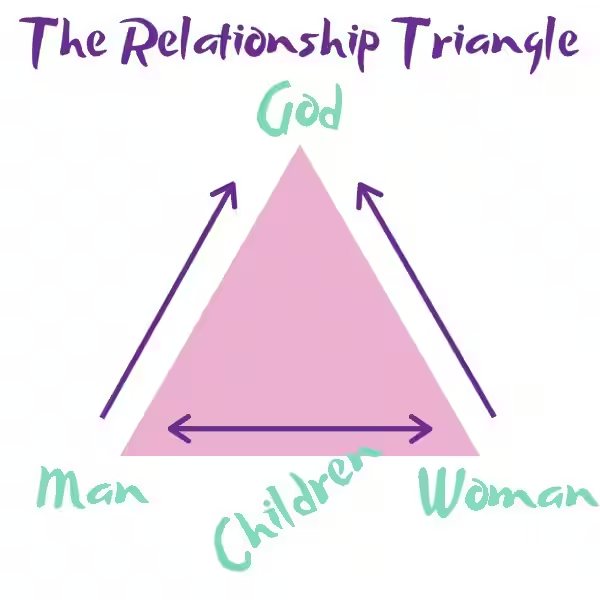
Genesis 1:27 states that both Adam and Eve were created in God's image. Their relationship, therefore, is seen as mirroring the Trinitarian relationship within the Godhead—a unity of distinct persons in loving fellowship. This understanding elevates their union beyond a mere societal construct to a theological reflection of God's own nature. The intimate connection between Adam and Eve directly reflects the deep, loving relationship within the Trinity itself.
This Trinitarian reflection underscores the profound significance of their relationship. It elevates it above a simple human partnership to a sacred representation of the divine. The love and fellowship they shared served as an embodiment of the divine love and communion.
The Procreation Mandate
Genesis 1:28 instructs humanity to "be fruitful and multiply." This procreative mandate is considered an integral part of the divinely ordained purpose of marriage. Adam and Eve's union, resulting in children, fulfills this mandate, further supporting the argument for their marital relationship. The procreation mandate is not simply a biological imperative but a sacred responsibility, a reflection of God's blessing and command to continue His creation.
The act of procreation is seen as a sacred act, a participation in God's creative work. It is a testament to the life-giving nature of their union, a continuation of the divine creative power. By fulfilling this mandate, Adam and Eve further affirmed their commitment to God's plan.
Counterarguments and Alternative Interpretations
While the arguments for Adam and Eve being married are compelling, some counterarguments exist. These often focus on the lack of explicit marital terminology and cultural differences between the ancient patriarchal world and modern society.
Some scholars suggest that Genesis describes a close relationship but not necessarily one conforming to modern legal or societal definitions of marriage. The absence of specific marital terms allows for a more flexible interpretation, possibly closer to a family unit or covenantal relationship not bound by the formal structures of later civilizations. This doesn't necessarily negate the profound bond between them but suggests a different understanding of the nature of their union within their unique historical context.
The absence of specific ritual or ceremony frequently cited as evidence of a non-marital union. However, the lack of detailed descriptions doesn't necessarily negate the essence of a marriage. The focus on their divine creation and creation of a family could supersede a need for formal ritualistic marriage.
Conclusion: A Divine Covenant
Were Adam and Eve husband and wife? The answer, while not explicitly stated in Genesis, is strongly implied by the text's narrative, context, and theological interpretations. The evangelical perspective, emphasizing God's institution of marriage, the "one flesh" unity, their creation in God's image, and the procreation mandate, strongly supports the view of their union as a divinely ordained and foundational model for marriage. While different interpretations exist, the weight of evidence strongly suggests that their relationship was indeed a marriage, even if it differed significantly from modern cultural understandings. The debate continues, highlighting the rich interpretive possibilities within the biblical text and the ongoing conversation about applying ancient narratives to contemporary contexts.
Here are some frequently asked questions regarding the marital status of Adam and Eve, drawing upon various theological and scholarly interpretations:
Did Adam and Eve have a formal marriage ceremony as we understand it today?
The biblical text doesn't describe a formal marriage ceremony like those common in later cultures. Genesis 2 details God's creation of Eve and her presentation to Adam, along with Adam's profound declaration of their connection ("This is now bone of my bones and flesh of my flesh"). Genesis 2:24, though not using the word "married," describes the foundational principle of marriage: leaving parents to cleave to one's spouse, becoming one flesh. This immediately follows Eve's creation and Adam's declaration, strongly implying the establishment of their marital union. While a specific ceremony isn't depicted, the narrative clearly depicts a profound and unique union.
What is the theological perspective on Adam and Eve's relationship?
Many Christians, especially Evangelicals, view Adam and Eve's relationship as the foundational model for marriage. This interpretation emphasizes several key points from Genesis:
God's Institution: Genesis 2:24 is considered a divine establishment of the marriage covenant before the fall, implying a divinely ordained institution rather than a mere cohabitation.
"One Flesh" Unity: This phrase signifies a comprehensive unity encompassing physical, emotional, and spiritual aspects, transcending modern understandings of marriage.
Image of God: Created in God's image, their relationship reflects the Trinitarian relationship within the Godhead, elevating their union beyond a societal construct.
Procreation Mandate: The command to "be fruitful and multiply" is seen as an integral part of their divinely ordained purpose. Their union and subsequent children fulfill this mandate.
However, it's crucial to note that alternative interpretations exist, focusing on the lack of explicit marital terminology and considering the societal context of the time.
What are some counterarguments to the idea that Adam and Eve were married?
Counterarguments center on the absence of explicit terms like "husband" and "wife" in the early Genesis accounts. Some scholars suggest that the Genesis narrative describes a close relationship, perhaps a family unit or covenantal relationship, but not necessarily one conforming to modern legal or societal definitions of marriage. The lack of specific marital terminology allows for a less rigid interpretation of their union.
How do different biblical translations handle the terminology?
While the Hebrew words "eesh" (often translated as "husband") and "issa" (often translated as "wife") have broader meanings, the context of Genesis clearly implies a marital relationship. Many English Bible translations consistently render these words as "husband" and "wife" in relevant passages, reflecting a widespread understanding of their union as a marriage.
What is the covenantal view of Adam and Eve's relationship?
Some scholars, drawing upon ancient Near Eastern treaty structures, interpret Adam and Eve's relationship as a covenant. This perspective highlights the elements of the narrative that resonate with ancient covenant agreements: God as suzerain, commands as stipulations, Adam's declaration as a pledge, God's pronouncements as blessings and cursings, and the consummation of their union as ratification. This framework suggests a formal, albeit verbally established, covenant relationship between Adam, Eve, and God, solidifying the understanding of their union as a divinely ordained marriage.
Does the lack of a written marriage contract negate the idea of marriage?
The absence of a formal written contract isn't considered a significant counterargument, particularly considering the historical context. Oral transactions were common in ancient Near Eastern marriages, and the biblical narrative itself relies heavily on oral tradition and divine revelation. The profound nature of their union and God's clear intention, as evidenced in the text, supersede the need for a written document.
In conclusion, whether Adam and Eve were "married" depends heavily on the interpretive lens used. While a formal ceremony isn't explicitly described, the theological implications of the Genesis narrative and its supporting scriptures strongly suggest a divinely ordained, profound, and lifelong union that serves as a foundational model for marriage, even if differing from contemporary cultural understandings. The ongoing debate highlights the complex nature of interpreting ancient texts within modern contexts.