The title "Son of Man" holds a captivating place in biblical studies, appearing prominently in both the Old Testament book of Ezekiel and the New Testament Gospels. However, the meaning and significance of this title differ dramatically depending on the context. Understanding this difference is crucial for a proper interpretation of both texts.
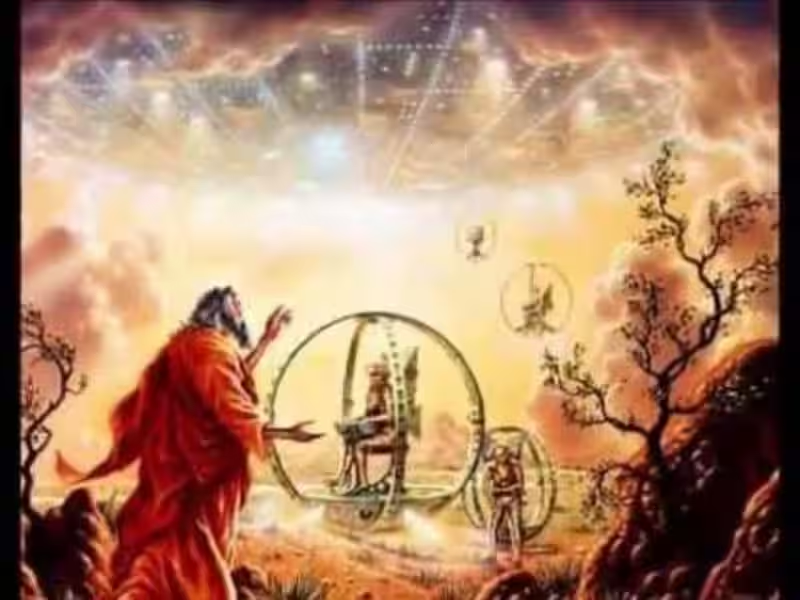
In the book of Ezekiel, the phrase "son of man" (Hebrew: ben-adam) is used over 90 times, almost exclusively as a direct address from God to the prophet. This isn't a grandiose title of messianic import; it's a simple, almost understated designation emphasizing Ezekiel's humanity.
God's repeated use of "son of man" serves to ground Ezekiel, to remind him—and the reader—of his limitations in the face of divine revelation. He is not God; he is a man, selected to deliver a challenging message. The phrase highlights the contrast between the prophet's human frailty and the immense power and authority of the God he serves. This humble designation underscores the profound responsibility placed upon a man tasked with communicating divine will.
It's important to remember that Ezekiel was a priest, a man from a lineage deeply connected to religious tradition. Yet, the title "son of man" stripped away any suggestion of inherent spiritual superiority, focusing instead on his shared humanity with the exiled Israelites he addressed. This emphasizes his relatability and underscores that he was chosen not because of any special divine status, but because of his willingness to serve.
The Human Element in Prophecy
The repeated use of "son of man" isn't random; it's a deliberate rhetorical device. It acts as a constant reminder of Ezekiel's humanity. He experiences doubt, fear, and even reluctance in his prophetic calling, much like any ordinary man. This relatable aspect of Ezekiel’s character makes his story more human and his message more powerful.
It directly contrasts with the supernatural visions and experiences he receives. It emphasizes that even the most extraordinary prophets are ultimately human, reliant on God's grace and guidance. The humanity of Ezekiel, highlighted by the constant appellation of "son of man," reinforces the powerful message of God's grace even amid human weakness. The repeated use strengthens the message that God works through imperfect vessels to achieve his divine purposes.
Jesus: The Son of Man, a Messianic Title
In stark contrast to Ezekiel's usage, Jesus uses the title "Son of Man" (Greek: υἱὸς τοῦ ἀνθρώπου – huios tou anthrōpou) approximately 88 times in the Gospels. Crucially, Jesus uses the definite article—"the Son of Man"—a key distinction. This subtle but significant addition changes the meaning entirely.
This usage connects directly to Daniel 7:13-14, a prophecy foretelling a coming figure with divine authority and an everlasting kingdom. By declaring himself "the Son of Man," Jesus explicitly identifies himself as the fulfillment of this ancient prophecy. The definite article elevates the title from a simple description of humanity to a claim of unique messianic identity.
A Title of Both Humanity and Divinity
Jesus's self-designation as "the Son of Man" is complex. It affirms both his true humanity and his divine authority. He is fully human, sharing in the experiences and limitations of humanity, yet he is also the promised Messiah, possessing divine power and authority. He is the perfect embodiment of humanity, a sinless man who bridges the gap between God and humanity.
The title "the Son of Man" doesn't diminish his divinity; it emphasizes the paradoxical nature of his person. He is both God and man, fully united in one person. His humanity allows him to empathize with human suffering, while his divinity empowers him to overcome sin and death. This dual nature is central to Christian theology, and the title "the Son of Man" plays a crucial role in understanding this multifaceted identity.
Comparing the Two Usages
The key difference lies in the context and the presence or absence of the definite article. For Ezekiel, "son of man" simply means "a man," emphasizing his humanity in his role as a prophet. For Jesus, "the Son of Man" is a messianic title, referencing a specific prophecy and claiming a unique, divine status. The addition of "the" transforms the meaning entirely.
The frequent repetition serves different purposes in each case. In Ezekiel, it underscores his human limitations, while in Jesus' usage, it repeatedly underscores his divine authority and future role. These distinct applications reveal the multifaceted nature of biblical language and interpretation; identical phrases can have vastly different meanings depending on the context.
The "son of man" in Ezekiel is not a precursor to the "Son of Man" in Jesus’ ministry. They are distinct theological concepts. While there may be a broad link between humanity’s fallen state and the need for redemption, the specific titles and their application in these books are separate considerations.
Linguistic and Contextual Nuances
A deeper examination reveals distinct linguistic roots. In Ezekiel, the Hebrew ben-adam is closely related to "son of Adam," linking Ezekiel's prophetic role to the human race's origins. In Daniel 7, the Aramaic kebar enash describes a heavenly figure, interpreted by Christians as a prefiguration of Jesus. The linguistic differences further highlight that the same English translation masks distinct meanings in their original languages.
In conclusion, while both Ezekiel and Jesus are called "son of man," the title holds vastly different significance. For Ezekiel, it emphasizes his human limitations. For Jesus, it signifies his messianic identity and his unique role in God's plan of salvation. Understanding the nuances of language, context, and theological implications is crucial to grasping the richness and depth of these biblical texts. The seeming simplicity of the phrase "son of man" belies a profound theological complexity.
Frequently Asked Questions: Why is Ezekiel Called “Son of Man”?
Why is Ezekiel repeatedly called "Son of Man" in the Bible?
The title "Son of Man" is used over 90 times in the book of Ezekiel, always in direct address from God. It emphasizes Ezekiel's humanity, contrasting it with God's transcendent nature. The repetition serves to humble the prophet, reminding him of his limitations while carrying out his divine task of delivering God's message. It simply means "a man," a human being, and carries no messianic or divine connotation in Ezekiel's context.
How does Ezekiel's use of "Son of Man" differ from Jesus'?
The key difference lies in the definite article. Ezekiel is called "son of man" (no "the"), highlighting his ordinary humanity. Jesus, however, refers to himself as "the Son of Man," connecting himself to the messianic figure prophesied in Daniel 7, claiming a unique and exalted status. For Jesus, the title signifies both his humanity and his divine nature, fulfilling Old Testament prophecy.
Does "Son of Man" in Ezekiel have any connection to Adam?
The Hebrew phrase used in Ezekiel, "ben-adam," translates literally as "son of Adam." This connection to Adam, the first man, might symbolically link Israel's exile to their origins and suggest a potential "new beginning" upon their return from Babylon. However, it primarily emphasizes Ezekiel's humanity as a messenger of God, not a divinely appointed messianic figure.
Is there a linguistic difference between the "Son of Man" in Ezekiel and Daniel?
Yes. Ezekiel uses the Hebrew phrase "ben-adam," while Daniel 7 uses the Aramaic "kebar enash." While both translate to "son of man," their contexts are vastly different. In Daniel, "kebar enash" describes a heavenly figure, often interpreted as a prefiguration of Jesus. In Ezekiel, "ben-adam" is a direct address to the prophet, underscoring his human limitations. Treating them as interchangeable ignores the distinct linguistic origins and contextual meanings.
Why did God choose to call Ezekiel "Son of Man" rather than other prophets?
The reason for God's choice remains unanswered in scripture. It's possible the title's frequent use in Ezekiel emphasizes the prophet's humility and the immense burden of his prophetic calling amidst the desolation of Israel's exile. Further research and theological interpretation are needed to fully understand God's specific choice of this title for Ezekiel.
Does the title "Son of Man" in Ezekiel imply any divine authority?
No. In the context of Ezekiel, the title "son of man" solely emphasizes his human frailty contrasted with his prophetic role. It does not imply any divine authority or messianic status. This is in stark contrast to Jesus' use of the title "the Son of Man."