How Many People Are in Heaven?

This question, seemingly simple, unravels into a complex tapestry of theological debate, historical uncertainty, and the inherent limitations of applying quantitative methods to matters of faith. Given that an estimated 109 billion people have ever lived, how many are currently in Heaven, Hell, or Purgatory? The answer, as we will see, is far from straightforward.
The Impossibility of a Precise Answer
The sheer scale of the problem immediately confronts us. Even accepting the existence of Heaven, Hell, and Purgatory as operational realities for the purpose of this inquiry—a crucial caveat given my agnostic perspective, informed by the teachings of Jesus but not necessarily the Abrahamic God—the task of assigning individuals to these destinations is essentially impossible. We lack reliable historical data on religious affiliation and adherence for the vast majority of those 109 billion people. Furthermore, the criteria for entering Heaven, Hell, or Purgatory vary wildly across different faiths and even within individual denominations.
Consider the difficulty in accessing reliable information about the religious beliefs of people who died centuries ago, let alone millennia. Even for more recent times, accurate records are often incomplete or biased. How could we possibly track the spiritual lives of people across countless cultures and eras, each with its unique understanding of the afterlife? The very concept of "how many people are in heaven" therefore raises serious methodological challenges.
Subjective Interpretations and Varying Beliefs
Beyond the practical obstacles of data acquisition, the fundamental premise of the question is itself deeply problematic. Defining the criteria for entry into Heaven, Hell, or Purgatory is a subjective process, heavily influenced by individual interpretations of religious texts and doctrines. What one religion considers virtuous might be viewed as sinful by another. What constitutes a "good life" or sufficient faith varies drastically across cultures and belief systems.
There's no single, universally accepted standard to judge an individual's "worthiness" of an afterlife destination. Any attempt at quantification, therefore, is inherently flawed and based on necessarily arbitrary assumptions. It's akin to trying to measure the weight of a cloud.
The Biblical Perspective: 144,000 and the Great Multitude
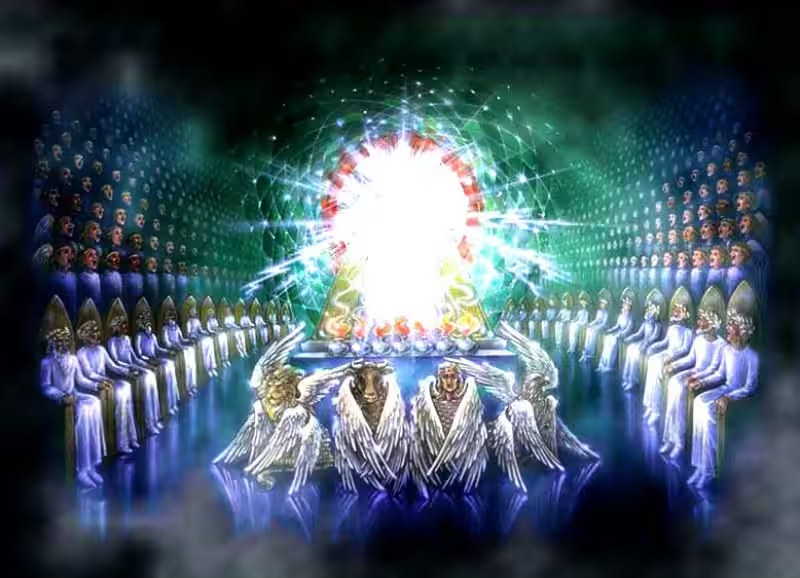
The Book of Revelation mentions 144,000 individuals gathered in God's kingdom. Many interpret this passage as a literal number of the saved. However, a more nuanced interpretation suggests that these 144,000 represent a priestly group, akin to Jesus' disciples, tasked with spreading the gospel and bringing others to faith. Their names being written on their foreheads symbolize a deep commitment and understanding.
Revelation also speaks of a "great multitude," a countless number of people from every nation, standing before God's throne. This vast multitude, far exceeding 144,000, likely represents those who have accepted the gospel message and found salvation through faith. The passage highlights that Heaven's capacity is far greater than the initial, often misinterpreted, number. The 144,000 are not the only saved; they are instrumental in leading many others to salvation.
The "Great Multitude" and the Scope of Salvation
The significance of this "great multitude" lies in demonstrating the expansive nature of God's grace. The number of people in heaven, therefore, is not limited to a select few but potentially encompasses a vastly larger group of those who have responded positively to the message of salvation. This expansive understanding counters the notion of a limited number of souls destined for Heaven. The focus shifts from a restrictive numerical count to the all-encompassing nature of divine love and the potential for salvation.
It is crucial to contextualize these biblical passages within the broader narrative of Christian theology, recognizing the symbolic and allegorical nature of much of the apocalyptic literature.
The Question’s True Value: A Philosophical Exercise
Ultimately, the question "how many people are in heaven?" serves less as a quantifiable problem and more as a philosophical exercise. It prompts reflection on the vastness of human history, the diversity of human experience, and the inherent limitations of applying empirical methods to questions of faith.
The Agnostic Perspective and Unknowable Truths
My agnostic perspective highlights the inherent uncertainty surrounding questions of the afterlife. While I find resonance in the teachings of Jesus, the question of an exact number of souls in Heaven remains fundamentally unknowable through empirical means. Any answer relies on faith, interpretation, and subjective judgment. The beauty and challenge lie in accepting this inherent unknowability.
Beyond Numbers: A Focus on Faith and Meaning
Rather than searching for a numerical answer, the quest to understand "how many people are in heaven" should redirect our focus to deeper questions. What constitutes a meaningful life? What is the nature of faith and belief? How do we navigate the complexities of diverse religious perspectives? These are the questions that truly matter, far surpassing the limitations of any numerical answer. The true value of this inquiry lies in its capacity to provoke profound contemplation on the nature of belief, judgment, and the meaning of life itself.
Frequently Asked Questions: How Many People Are in Heaven?
This FAQ section addresses the question of how many people are in Heaven, acknowledging the inherent complexities and limitations in attempting a definitive answer. The perspective presented is that of an agnostic who accepts the concepts of Heaven, Hell, and Purgatory as operational realities for the purpose of this discussion, but does not necessarily subscribe to a specific theological system.
How many people have gone to Heaven, Hell, or Purgatory throughout history?
It's impossible to provide a precise numerical answer. An estimated 109 billion people have lived, with about half dying in the last 2000 years. However, reliable data on religious beliefs and practices throughout history is incredibly scarce and inconsistent. The criteria for assigning individuals to these destinations also vary dramatically across different belief systems, making any universal calculation impossible. The question itself highlights the inherent limitations of applying quantitative methods to fundamentally qualitative and faith-based concepts.
Does the Bible give a number for those in Heaven?
Revelation mentions 144,000 individuals gathered in God's kingdom, but this is widely interpreted as a priestly group, not the total number of the saved. A "great multitude," a countless number of people, is also described in Revelation, suggesting a far larger number of those in heaven. The 144,000 are seen as instrumental in bringing others to salvation. The exact number remains unknown and open to interpretation.
Are people from the Old Testament currently in Heaven?
Based on certain interpretations of scripture (like John 3:13 and Acts 2:29), some believe that those faithful before Jesus's resurrection aren't currently in Heaven. The argument posits that heavenly ascension wasn't possible before Jesus' sacrifice and subsequent resurrection. Their future is linked to a future earthly resurrection, not immediate heavenly ascension. This interpretation however, is subject to various theological viewpoints.
Is there a definitive way to determine who goes to Heaven, Hell, or Purgatory?
No. The criteria for determining an individual's ultimate destination vary widely across religious beliefs and interpretations of scripture. There's no objective, universally accepted standard. This makes any attempt to quantify the number of people in each location fundamentally subjective and impossible.
Why is this question important if we can't get a numerical answer?
The question's value lies not in finding a number but in highlighting the vastness of human history and the diversity of belief systems. It challenges us to consider the subjective nature of assigning ultimate destinies and the limitations of applying empirical methods to matters of faith and the afterlife. It encourages reflection on the nature of belief, judgment, and the concept of an afterlife itself.