Ash Wednesday Pagan Origin: Unpacking the History of a Christian Observance
Ash Wednesday Pagan Origin: Unpacking the History of a Christian Observance
Many Christians observe Ash Wednesday, marking the beginning of Lent, a period of reflection and repentance. But did you know that some question the origins of this significant Christian practice, suggesting a possible connection to pre-Christian traditions? This article explores the intriguing claims surrounding Ash Wednesday's pagan origin, examining the evidence and offering a balanced perspective.
Some critics vehemently argue that Ash Wednesday, and Lent itself, are not authentically Christian, but rather pagan practices adopted and adapted by the Catholic Church. This perspective paints a stark picture, depicting the juxtaposition of Mardi Gras's revelry leading directly into the penitence of Ash Wednesday as a form of spiritual hypocrisy. The argument centers on the use of ashes as a fundamentally unbiblical ritual, suggesting a corruption or "falling away" from true Christian faith – a form of apostasy.
The criticism goes further, with some alleging that the entire practice represents a larger problem within the Catholic Church. Such strong criticisms, however, often lack specific scriptural references to support their claims, relying instead on a general sense of incompatibility between the ritual and what they perceive as genuine Christian principles. The absence of counterarguments or alternative interpretations within these critical perspectives weakens their overall analysis. The inflammatory language used often overshadows any potential historical or theological merit that might be found in the practice.
It’s important to note that these extreme views represent only one interpretation, and do not reflect the beliefs of all Christians. Many find rich spiritual meaning in the traditions of Lent and Ash Wednesday.
Exploring Possible Pagan Connections: The Ash Wednesday Ritual
The use of ashes in religious contexts predates Christianity by centuries. Several ancient cultures used ashes in rituals related to purification, death, and rebirth. This historical precedence has led some to suggest that the Ash Wednesday ritual might have pagan origins, even if indirectly.
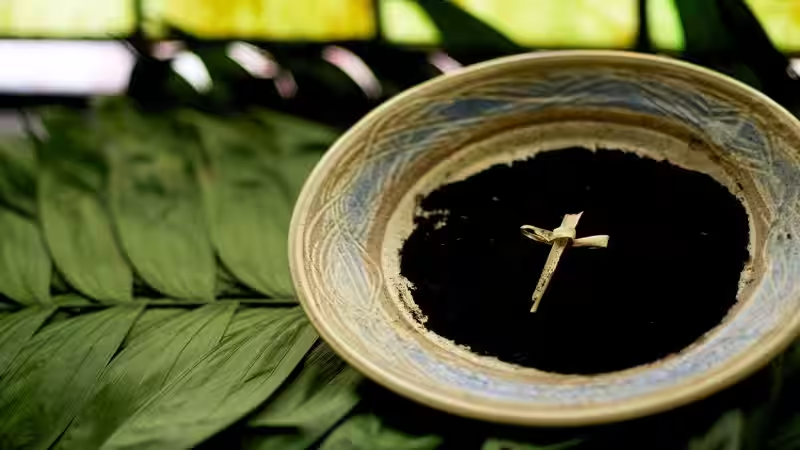
The symbolism of ashes is multifaceted. In many ancient cultures, ashes represented death, decay, and the cyclical nature of life. This resonates with the Christian theme of repentance and the turning away from sin, symbolized by the ashes placed on the forehead. Moreover, the phoenix, a mythical creature that rises from ashes, offers a powerful metaphor for resurrection and renewal, mirroring the Christian concept of spiritual rebirth through repentance.
Wednesday's Etymology and Potential Connections
The day itself, Wednesday, offers another avenue for exploration. In many Germanic languages, Wednesday is linked to Wotan (Odin), the chief god in Norse mythology. However, a direct connection between Odin and the use of ashes in rituals is not evident in traditional Norse mythology.
The connection might instead lie in a broader concept of purification and rebirth, or even a syncretism where existing pagan practices were woven into the developing Christian framework. It’s important to note that these are speculative connections, requiring further historical and anthropological investigation.
Other potential links have been explored, including associations with ancient Middle Eastern deities associated with death and renewal. These connections, however, remain largely speculative and require more robust scholarly investigation to validate.
Alternative Interpretations: A More Nuanced View
While the strong criticisms against Ash Wednesday as inherently pagan are compelling in their rhetoric, a balanced view requires acknowledging the complexities of religious syncretism. The development of early Christianity often involved the incorporation and reinterpretation of existing cultural practices.
The imposition of ashes may have been a way to connect with existing cultural understandings of purification and repentance, making the transition to Christianity more accessible to those with pre-existing beliefs. This doesn't necessarily imply a rejection of the Christian faith, but rather a process of cultural adaptation.
The imposition of ashes, therefore, might not represent a direct "hijacking" of pagan practices, but rather a strategic adaptation of existing symbols and rituals to communicate a Christian message of repentance and renewal. This interpretation, therefore, reframes the discussion of Ash Wednesday's pagan origin from one of condemnation to one of complex cultural exchange.
Modern Interpretations and Personal Reflections
Regardless of Ash Wednesday's ultimate origins, its significance for many Christians remains profound. The ritual serves as a powerful reminder of mortality, the need for repentance, and the promise of redemption. The practice of self-reflection and penitence during Lent provides an opportunity for spiritual growth and renewal, regardless of its historical origins.
For example, observing Lent might involve focusing on eliminating negativity from one’s life – negative thoughts, comments, or harmful relationships – and replacing them with positivity and encouragement. This personal approach underscores the enduring power of Lenten practices to promote self-reflection and personal growth, allowing for individual interpretation and application.
The question of Ash Wednesday's pagan origin remains open to interpretation. While some argue for a direct link to ancient practices, others see it as a complex process of cultural adaptation. Ultimately, the meaning and significance of Ash Wednesday are deeply personal, and the practice’s richness lies not only in its historical context but also in its continued ability to inspire reflection, repentance, and spiritual growth.
Frequently Asked Questions: Ash Wednesday and its Pagan Origins
What is the main argument regarding Ash Wednesday's pagan origins?
The primary argument centers on the lack of direct biblical evidence supporting the practice of ash imposition on Ash Wednesday. Several theories suggest its origins lie in pre-existing pagan traditions. These theories propose that the ritual's use of ashes and its placement on the forehead, along with the day's association with names linked to deities like Odin, might point to the adoption and adaptation of existing pagan practices into the Christian liturgical calendar. The argument doesn't necessarily claim all aspects of Ash Wednesday are pagan, but rather that certain elements, particularly the ash ritual itself, may have been influenced by or derived from pre-Christian religious practices. It highlights a potential syncretism where existing symbolic practices were reinterpreted within a Christian framework. Importantly, this is a theory, not a universally accepted fact.
Are there specific pagan traditions linked to Ash Wednesday?
Several potential connections have been proposed. Some scholars point to the Norse god Odin, whose name is etymologically linked to the word "Wednesday," and whose association with ashes (and the related concept of the "World Ash", Yggdrasil) might suggest a link. Additionally, connections have been drawn to Vedic traditions, where ashes, associated with fire gods like Agni, held significance in purification rituals. Similarities to practices involving Shiva, the Hindu god, are also noted. These connections suggest a possible evolution where existing symbolic uses of ashes in purification rituals were reinterpreted and integrated into the emerging Christian tradition. It's important to remember that these are proposed links, and further research is needed to confirm or refute them definitively.
Does the argument claim all Christian holidays have pagan origins?
While some sources make broader claims about the pagan origins of various Christian holidays, the specific focus of the inquiry here is on the Ash Wednesday ritual itself. The argument concentrates on the limited biblical support for the practice of ash imposition and explores possible pre-Christian influences on this specific aspect of the Christian liturgical calendar, not on the entirety of the Christian faith or its holidays.
What is the significance of the day being Wednesday?
The argument notes that the name "Wednesday" has etymological roots connected to various deities from different cultures, including Wotan (Odin) in Germanic mythology and Mercury (Hermes) in Roman mythology. This connection is used to highlight the possibility of the day itself having pre-Christian significance, potentially influencing the choice of this day for the imposition of ashes. However, it's crucial to understand that the association of these deities with ashes is not firmly established within established mythology; the link is speculative and offered as a potential factor contributing to the overall discussion of pagan influences.
How strong is the evidence for a pagan origin of Ash Wednesday?
The evidence presented is largely circumstantial and interpretative. While connections are drawn between the practice of ash imposition, the day's name, and various ancient practices involving ashes and purification, they lack the conclusive proof needed to definitively establish a direct causal link. The scholarly rigor of such claims varies widely depending on the source and the type of evidence used. The lack of direct historical documentation linking the current ritual to these specific pagan practices weakens the argument's strength. The discussion is primarily speculative and presents various interpretations, rather than presenting definitive conclusions.