Unpacking the Pagan Origin of Ash Wednesday: A Journey Through Time and Tradition
Unpacking the Pagan Origin of Ash Wednesday: A Journey Through Time and Tradition
The observance of Ash Wednesday, a cornerstone of the Christian liturgical calendar, prompts a fascinating question: are its roots solely within the Christian faith, or does it carry echoes of older, pagan traditions? While the Church presents a clear narrative connecting Ash Wednesday to penitence and the Lenten season, exploring its origins reveals a potentially more complex and layered history. This article delves into the possibility of a pagan origin for Ash Wednesday, examining various potential influences and acknowledging the limitations of definitively tracing its origins.
The Curious Case of Wednesday: A Pagan Connection?
The very day of the week on which Ash Wednesday falls – Wednesday – offers a potential avenue for exploring pagan influences. The name "Wednesday" itself is derived from "Woden's Day" (or "Odin's Day"), referencing the chief god in Norse mythology. This connection immediately raises questions about potential historical links between the Christian observance and pre-Christian practices. This isn't a direct link to ash specifically, but the association with a particular day of the week, dedicated to a powerful pagan deity, suggests the possibility of a pre-existing framework into which the Christian practice was woven.
It's worth noting that the association with Wednesday isn't exclusive to Norse mythology. In Roman tradition, Wednesday was associated with Mercury (Hermes in Greek mythology), the god of commerce, travel, and communication. While there's no readily apparent established myth involving ash directly associated with either Wotan/Odin or Mercury, the association with a day named for prominent pagan deities hints at a potential appropriation of an existing day of significance.
The Phoenix and the Ashes: A Symbol of Rebirth?
Perhaps the connection to paganism isn't directly tied to a specific deity's ash-related rituals, but to a broader theme of death and rebirth. The mythical Phoenix, a creature that cyclically burns itself to ashes and rises again, embodies this theme powerfully. This cycle of destruction and renewal strongly resonates with the Lenten season, a period of spiritual reflection, sacrifice, and the anticipation of Easter's resurrection. This symbolic self-immolation and subsequent renewal could be interpreted as a powerful metaphor underlying the Christian observance, even if the direct link to a specific pagan god is tenuous.
The use of ashes in Christian ritual – symbolizing mortality and repentance – could be interpreted as a symbolic adoption of this powerful pagan image, transforming its meaning within the Christian context. This suggests a process of cultural and religious syncretism, where existing symbols and practices were reinterpreted and integrated into the emerging Christian faith.
A Middle Eastern Alternative: Forgotten Deities and Lost Rituals
Another potential origin for Ash Wednesday might lie in the ancient Middle East. The region boasts a rich tapestry of religious traditions with deities associated with death and renewal, some of whose festivals might have been appropriated or adapted by the early Church. The possibility exists that an earlier, possibly unnamed, deity held prominence in a death and renewal cycle, whose rituals involved ash, and whose day of worship might have coincided with the current Wednesday.
The lack of easily identifiable deities directly associated with ash in pre-Christian traditions adds to the complexity. This absence of a clear "ash god" doesn't negate the possibility of a pagan origin, but rather suggests that the practice might have evolved through a confluence of cultural and religious influences, with the "ash" aspect being a general symbol of repentance and cleansing rather than a specific attribute of a single deity.
The Absence of Explicit Biblical References: A Significant Gap
The lack of explicit biblical references to ash or the practice of anointing with it further strengthens the argument for a possible pagan origin. While the Bible emphasizes repentance and self-denial, it doesn't prescribe the use of ashes as a ritualistic practice. This absence of direct scriptural support suggests a potential adoption or adaptation of pre-existing customs, rather than a practice directly derived from Jesus's teachings. The integration of such a practice within the Christian tradition speaks to the fluid and dynamic nature of religious practice through history.
This lack of direct biblical grounding doesn't automatically invalidate Ash Wednesday's significance within the Christian faith, but it does invite us to consider the possibility of a more complex and layered history involving the assimilation of pagan customs and beliefs.
Conclusion: An Open Question and a Call for Further Investigation
The pagan origin of Ash Wednesday remains an open question. While definitive proof is lacking, the evidence presented – the association with Wednesday, the symbolic resonance with the Phoenix myth, and the absence of clear biblical precedent – suggests the possibility of a pre-Christian influence. This isn’t to dismiss the significance of Ash Wednesday within Christian faith but to recognize its potential development through a process of cultural adaptation and appropriation. It's a reminder that religious practices often evolve, incorporating elements from diverse sources over time, creating a rich and sometimes perplexing tapestry of tradition.
Further research and historical investigation are needed to fully unveil the origins of this fascinating practice. The exploration of its possible pagan origins allows for a deeper understanding of the complexities of religious syncretism and the ongoing interplay between different cultural and religious influences throughout history. The ambiguity surrounding its origins highlights the enduring power of symbols and rituals to transcend specific faiths and resonate across time and cultures.
Frequently Asked Questions: The Pagan Origins of Ash Wednesday?
This FAQ addresses the complex and debated origins of Ash Wednesday, exploring the possibility of pagan influence without definitively claiming it as fact. The lack of conclusive evidence necessitates a nuanced approach.
Is Ash Wednesday definitively of pagan origin?
No definitive proof exists to confirm Ash Wednesday's exclusively pagan origin. While the lack of direct biblical reference to ash anointing is noteworthy, the observance's evolution likely involved the adoption and adaptation of pre-existing customs and symbolism. The possibility of influence from various ancient cultures, rather than a singular source, is a more likely scenario.
What are the arguments suggesting pagan roots?
Several arguments suggest potential pagan influences:
Day of the week: The observance falling on a Wednesday, historically associated with Wotan (Odin) in Norse mythology and Mercury in Roman mythology, raises questions about possible connections. However, a direct link to ash-related rituals connected to these deities remains unproven.
Symbolism of ash: Ashes, representing death, purification, and rebirth, feature prominently in various mythologies. The Phoenix myth, for example, highlights the cyclical nature of death and renewal, a theme resonating with the Lenten season.
Possible Middle Eastern origins: Another hypothesis suggests a possible origin in ancient Middle Eastern religions, potentially linked to a death and renewal deity whose festival was later appropriated. This remains speculative due to a lack of specific evidence.
If pagan influences exist, what specific deities are linked?
No single deity is definitively linked to Ash Wednesday's alleged pagan origins. While the day of the week (Wednesday) suggests potential links to Wotan/Odin or Mercury, there's no established myth directly connecting them to ash-related ritual practices. The connection to the Phoenix myth is more thematic, reflecting the broader concept of death and rebirth, rather than a specific deity's worship. The possibility of an unknown Middle Eastern deity remains a compelling, but unproven, hypothesis.
How has the Christian church interpreted the use of ashes?
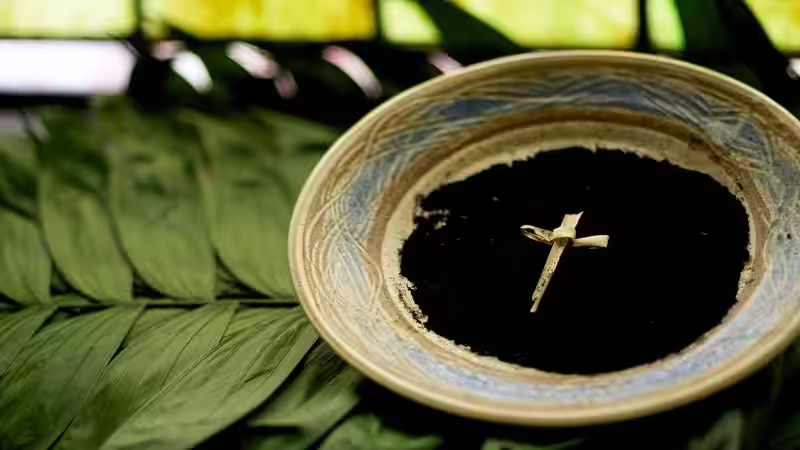
The Christian church interprets the imposition of ashes as a symbolic representation of repentance, mortality, and the need for spiritual renewal. It's a visual reminder of human frailty and a call to turn towards God. The church does not explicitly acknowledge pre-Christian influences in its official theological interpretations.
Does the lack of clear evidence disprove pagan influence?
The absence of definitive evidence doesn't disprove pagan influence; it simply highlights the complexity of the issue and the limitations of our current historical knowledge. The evolution of religious practices often involves the blending and adaptation of existing symbols and rituals. Further historical research might uncover additional connections.
What is the current scholarly consensus on this topic?
There is no single, universally accepted scholarly consensus on the exact origins of Ash Wednesday. The topic remains a subject of ongoing debate and interpretation, with some scholars emphasizing the Christian theological development while others acknowledge the potential for earlier, pre-Christian influences. The lack of definitive evidence allows for multiple interpretations.