Understanding the Guardian Redeemer: Boaz, Ruth, and the Legacy of Redemption
Understanding the Guardian Redeemer: Boaz, Ruth, and the Legacy of Redemption
The term "kinsman-redeemer," often translated as redeeming relative, carries deep significance within the context of the Book of Ruth and Ancient Near Eastern culture. This article explores the multifaceted role of the kinsman-redeemer, examining its legal, social, and theological implications, to arrive at an understanding of its lasting legacy.
The Multifaceted Role of the Kinsman-Redeemer (Go’el)
The Hebrew word Go'el, translated as kinsman-redeemer or redeeming relative, carried a complex set of responsibilities within ancient Israelite society. It wasn't simply a title of kinship — it denoted a legal and moral obligation toward family and community.
This obligation wasn't merely a matter of family affection but a legally binding duty with significant social consequences. Failing to meet these obligations could lead to social ostracism and loss of standing within the community. A kinsman-redeemer's actions were crucial for maintaining family integrity, property, and social standing.
Legal Redemption: Restoring What Was Lost
One of the most prominent aspects of the kinsman-redeemer's role was legal redemption. If a family member fell into poverty, debt slavery, or lost their land, the Go'el was responsible for buying back their property or freeing them from servitude. This act wasn't purely charitable — it served to protect the family line and its landholdings, which were vital to its survival and standing. Redemption restored the individual's position and ensured the family's continued prosperity.
In practice, this meant that when someone was forced to sell their family inheritance due to debt, the kinsman-redeemer stepped in as a legal intermediary. He made the necessary payment and recovered that land to keep it within the family circle. It was a social mechanism that prevented the fragmentation of estates and the disappearance of entire families from the community structure.
Avenging Wrongs: Protecting the Family’s Honor
Beyond financial matters, the Go'el also had a duty to avenge wrongs committed against a family member. This could involve pursuing legal remedies or, in more extreme cases, taking direct action. This aspect highlighted the kinsman-redeemer's role as protector of the family's honor and well-being, ensuring justice was done and the family's reputation remained intact.
This duty reflected an important reality of ancient societies: collective honor. A wrong committed against one family member wasn't simply a private matter — it was an attack on the dignity of the whole group. The kinsman-redeemer acted as defender of that shared dignity, restoring social balance through compensation or justified retaliation.
Procreation and Legacy: Ensuring the Family’s Continuity
In cases where a male heir was lacking, the kinsman-redeemer was responsible for marrying the deceased relative's widow (levirate marriage) and fathering children on his behalf. This practice, known as levirate marriage, ensured the continuation of the family line, preventing the family name from dying out and the loss of inheritance. This aspect is particularly crucial for understanding the narrative of Ruth.
Levirate marriage wasn't a casual arrangement but a well-defined legal institution. It allowed the inheritance rights and name of the deceased to carry on through his children, even though the biological father was someone else. It was a way of honoring the dead and preserving their memory within the family and social structure.
Boaz: The Perfect Example of a Kinsman-Redeemer
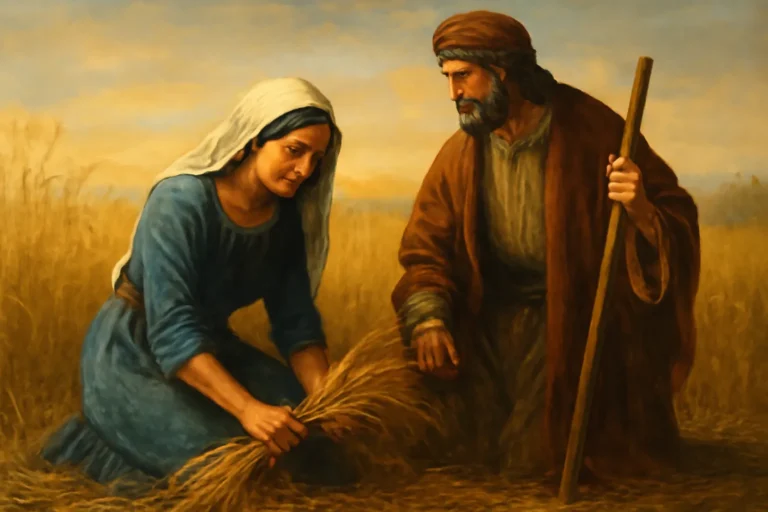
The story of Ruth offers a powerful illustration of the kinsman-redeemer in action. Boaz, a wealthy landowner, perfectly embodies the ideal of the Go'el through his actions toward Naomi and Ruth.
Boaz's Threefold Redemption
Boaz's actions demonstrate a complete fulfillment of the Go'el's obligations:
Legal redemption — He redeems Naomi's land, securing her ancestral property and providing economic stability for her future.
Avenging wrongs (implicitly) — By marrying Ruth, he restores her honor and provides for her well-being, implicitly avenging the losses she suffered through her husband's death and the hardships she faced. His actions offer her protection and a secure future.
Procreation and legacy — By marrying Ruth, he ensures the continuation of Elimelech's line, preserving the family name and securing Naomi's future. This act is foundational to establishing the line of King David and, ultimately, of Jesus Christ.
Boaz's actions extend beyond his immediate family — they represent a model of faithfulness and responsibility within the community. His compassion and loyalty exemplify the ideal of the kinsman-redeemer, showing the importance of community support and the strength of family bonds within ancient Israelite society.
It's important to understand that Boaz wasn't acting under compulsion — he exercised his right and duty with generosity. He could have turned Ruth away, a Moabite foreigner, but instead chose to open his heart and his estate to her. This decision reveals something profound about the character of a true kinsman-redeemer: he wasn't just someone fulfilling the law, but someone living out its values with integrity and mercy.
The Theological Significance: From Boaz to Jesus
The story of Ruth and Boaz transcends its historical and cultural context, carrying profound theological implications. The descendants of Ruth and Boaz include King David and, ultimately, Jesus. This lineage establishes a powerful connection between the Old Testament concept of redemption and the New Testament reality of salvation through Jesus.
This connection highlights God's ongoing work of redemption throughout history. Boaz's actions foreshadow the ultimate act of redemption offered by Jesus. Just as Boaz redeemed Ruth and Naomi, Jesus, the ultimate kinsman-redeemer, redeems humanity from sin and death, offering lasting reconciliation with God. This redemption provides a fresh start, a restored relationship, and the promise of eternal life.
The story of Ruth isn't merely a historical narrative but a powerful prophetic foreshadowing of God's saving grace. The narrative of Boaz and Ruth thus becomes a testimony to God's unwavering love and dedication toward His people. It demonstrates His consistent work of renewal and restoration, foreshadowing the ultimate act of redemption found in Jesus. The seemingly simple act of a kinsman-redeemer in ancient Israel transforms into a powerful symbol of God's enduring grace and the promise of salvation for all who believe.
This legacy of redemption resonated deeply within both Jewish and early Christian contexts, and it remains significant today. For the modern reader, the story is a reminder that God doesn't abandon His people in their moments of need — He acts through faithful, compassionate people to restore and renew. It's a story that continues to resonate with readers today, offering hope and a powerful illustration of God's unwavering love and faithfulness. The legacy of the kinsman-redeemer extends far beyond the pages of the Book of Ruth, reaching all the way to the ultimate act of redemption offered through Jesus.
Frequently Asked Questions: The Kinsman-Redeemer (Go’el)
What is a kinsman-redeemer (Go'el)?
A kinsman-redeemer, or Go'el, was a significant figure in Ancient Near Eastern society, particularly within Israelite culture as described in the Book of Ruth. More than simply a relative, the Go'el held a legal and social responsibility toward his kin. This responsibility encompassed several key roles, including the legal redemption of family members from debt or loss of land, avenging wrongs committed against the family, and ensuring the continuation of the family line through marriage (when necessary).
The concept of the Go'el was fundamental to Israelite social cohesion. In an era without state welfare systems or institutional insurance, the kinsman-redeemer provided a family safety net that protected vulnerable community members from falling into extreme poverty or permanent slavery.
What are the key responsibilities of a kinsman-redeemer?
The Go'el's responsibilities were multifaceted and demanding:
Responsibility
Description
Purpose
Legal redemption
The Go'el was obligated to buy back property or free family members from debt slavery or servitude
Maintain family integrity and landholdings
Avenging wrongs
The Go'el acted as protector, seeking justice for wrongs committed against family members, whether through legal channels or other means
Protect family honor and restore social balance
Procreation and legacy
In the absence of a male heir, the Go'el would marry the deceased relative's widow (levirate marriage), ensuring the continuation of the family line and inheritance
Preserve the deceased's name and inheritance rights
How does Boaz exemplify the role of a kinsman-redeemer in the Book of Ruth?
Boaz perfectly embodies the Go'el in the Book of Ruth, demonstrating all three functions in an integrated, generous way:
Legal redemption — He redeems Naomi's land, securing her family's economic future and honoring ancestral inheritance rights.
Avenging wrongs (implicitly) — By marrying Ruth, he restores her social standing after widowhood and provides security, implicitly avenging the hardships she faced as a widowed foreign woman in a foreign land.
Procreation and legacy — His marriage to Ruth ensures the continuation of Elimelech's line, keeping the family name from disappearing and ensuring his children inherit properly.
What makes Boaz remarkable is that he doesn't just fulfill his legal obligations — he carries them out with an attitude that goes beyond what's required. He actively seeks Ruth and Naomi's well-being, showing a compassion that sets a high moral standard for what it means to be a true kinsman-redeemer.
What is the theological significance of the kinsman-redeemer in the Book of Ruth?
Boaz's actions serve as a powerful illustration of faithfulness and responsibility. His story foreshadows the ultimate kinsman-redeemer, Jesus. The line of Ruth and Boaz leads to King David and, ultimately, to Jesus, highlighting the continuity of God's redemptive work throughout the Old and New Testaments.
Boaz's actions foreshadow the ultimate redemption offered by Jesus, who rescues humanity from sin and restores our relationship with God. The story emphasizes God's consistent love, renewal, and the promise of salvation. In the Christian context, Jesus becomes the supreme Go'el — the one who redeems not just property or honor, but human souls from the bondage of sin.
This theological connection transforms the narrative of Ruth from a simple story of rural romance into a testimony to God's plan for redemption. Each of Boaz's actions reflects aspects of what Jesus would later accomplish: buying back what had been lost (our relationship with God), restoring honor to the dishonored (sinners), and creating a new spiritual lineage (the Church).
Is the concept of the kinsman-redeemer purely legal?
No. While the Go'el carried significant legal responsibilities, the role also involved deep ethical and social obligations. It was about protecting family honor, ensuring relatives' well-being, and maintaining the integrity of the community. The Go'el's actions reflected the values and social structures of ancient Israelite society.
In fact, the true essence of the kinsman-redeemer transcended mere legal compliance. It was a calling to live with integrity, mercy, and dedication toward the most vulnerable. The kinsman-redeemer was the guardian of social cohesion, someone who recognized that one person's prosperity was interconnected with the prosperity of everyone in their family circle.
The story of Boaz and Ruth illustrates how law and compassion could — and should — work together. Boaz didn't fulfill his duty simply because he was obligated to, but because he understood that the true meaning of being a kinsman-redeemer lay in restoring dignity and hope to those who had suffered loss. This balance between legal duty and moral motivation is what makes his story remain so relevant and transformative for the modern reader.