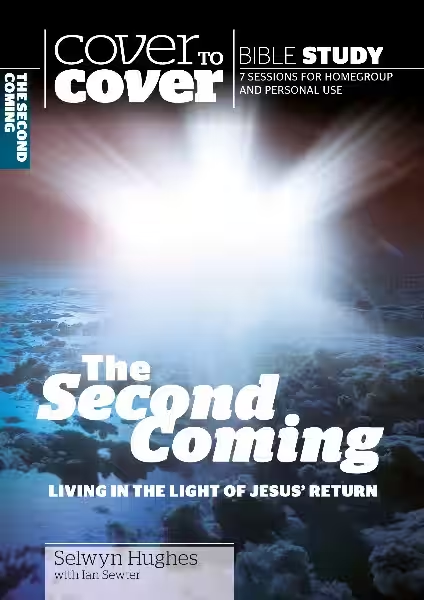
Many people wonder about the Second Coming of Christ and seek to understand its meaning and implications. While there isn't a single, universally accepted "Book of the Second Coming," several books explore this topic from various religious and spiritual perspectives. This article will focus on one such book, offering a unique interpretation of the Second Coming and Jesus' teachings: Paramahansa Yogananda's The Second Coming of Christ: The Resurrection of the Christ Within You.
Paramahansa Yogananda’s The Second Coming of Christ
This two-volume work, posthumously published, isn't a straightforward biography of Jesus. Instead, it presents a chronological narrative of Jesus' life interwoven with Yogananda's insightful commentary. The book's core thesis is that Jesus' teachings aren't just historical events but a path towards inner spiritual awakening. This awakening, Yogananda suggests, is the true meaning of the Second Coming—a resurrection of Christ consciousness within each individual.
Yogananda, a renowned Indian yogi, spent much of his life in America, bridging the gap between Eastern and Western spiritual traditions. He believed in the fundamental unity of seemingly disparate faiths like Christianity and Yoga, emphasizing their shared scientific foundation in universal spiritual principles. This belief formed the basis of The Second Coming of Christ, drawing from years of lectures, articles (including a series explicitly titled "The Second Coming of Christ"), and writings on the Gospels and the Bhagavad Gita. His disciples, after his passing, compiled these extensive materials – including stenographic records from his talks and writings from his magazine, East-West/Inner Culture – into the comprehensive two-volume work.
Unlike many interpretations focusing solely on the literal, physical return of Jesus, Yogananda's work emphasizes the internal transformation. He connects Kriya Yoga, a specific yogic technique, to the core of Jesus' teachings, proposing it as a practical method for achieving Christ consciousness. He explains that the true Second Coming is not just a future event but an ongoing process available to everyone.
The book analyzes Jesus' parables and ministry, but always through the lens of this unifying spiritual principle. It doesn't dismiss the historical Jesus but rather expands on the deeper, transformative potential of his message. Yogananda seeks to demonstrate how the teachings of Jesus and the practices of Yoga can lead to the same spiritual destination.
Critical Acclaim and Influence
The Second Coming of Christ has garnered considerable critical acclaim. Reviewers have praised its "bridge-building" nature, its ability to unify seemingly disparate religious traditions, and its profound insights into the deeper meaning of Jesus' teachings. The book's impact extends beyond academic circles; its accessibility and powerful message have resonated deeply with readers from diverse spiritual backgrounds.
Larry Dossey, M.D., lauded its importance as an analysis of Jesus' teachings, particularly emphasizing its contribution to healing and fostering unity across cultures. The Los Angeles Times praised its "startling ideas" about the relationship between Jesus' teachings and Yoga. Robert Ellwood, a leading religious studies professor, highlighted its potential to reshape the way people perceive Jesus and his teachings. Furthermore, the book has received several awards, including recognition as the best spiritual/religious book at the International Latino Book Awards. These accolades reflect the significant influence and widespread appreciation of Yogananda's unique interpretation of the Second Coming.
Beyond a Commentary
The Second Coming of Christ is more than just a commentary on the Gospels; it's a comprehensive theological and spiritual treatise. It proposes a unifying vision of spirituality, highlighting the inherent interconnectedness of major religious traditions and the potential for individual spiritual realization. Yogananda's work is a testament to the universality of spiritual truth and the power of inner transformation, offering a profound and practical pathway to understanding and experiencing the "Second Coming" in a deeply personal and transformative way. It is a valuable resource for anyone seeking to deepen their understanding of Jesus' teachings, explore the connections between different spiritual traditions, and embark on a journey of self-discovery and spiritual growth. The book, while extensive, offers profound insights into the meaning of the Second Coming and the path towards spiritual awakening. Its message of unity and self-realization continues to inspire readers and seekers worldwide. The abridged version, The Yoga of Jesus, provides a more accessible entry point for those interested in exploring Yogananda's unique perspective. Ultimately, exploring what this book offers provides a unique and enriching path to understanding the concept of the Second Coming and its relevance to one's personal spiritual journey.
Frequently Asked Questions: The Second Coming of Christ by Paramahansa Yogananda
What is The Second Coming of Christ: The Resurrection of the Christ Within You?
The Second Coming of Christ is a two-volume work by Paramahansa Yogananda, posthumously published. It's not a traditional biography of Jesus, but rather a chronological narrative of Jesus' life interwoven with Yogananda's insightful commentary. The book aims to reveal the harmony between original Christianity and original Yoga, proposing that both share a common scientific foundation in universal spiritual principles. Yogananda argues that Jesus’ teachings aren't merely historical events, but a pathway to inner spiritual awakening.
What is the central thesis of the book?
Yogananda's central thesis emphasizes the "resurrection of the Christ within you." He suggests that the essence of Jesus' teachings lies in achieving a direct experience of Christ consciousness—a state of spiritual awakening attainable through spiritual practice. He links Kriya Yoga, a specific yogic technique, to the essence of Jesus' teachings, presenting it as a practical method for realizing this Christ consciousness. The book interprets Jesus' parables and ministry through this lens of inner spiritual transformation.
How does the book relate Christianity and Yoga?
Yogananda posits that Christianity and Yoga are not contradictory but share a common root in universal spiritual principles. He draws parallels between Jesus' teachings and yogic practices, demonstrating their shared emphasis on self-realization and spiritual growth. The book serves as a bridge between these two seemingly disparate traditions, advocating for their unity and mutual enrichment.
What is the source material for the book?
The book is compiled from Yogananda's extensive lectures and writings on the Gospels and the Bhagavad Gita. Years of lectures and articles, including a series specifically titled "The Second Coming of Christ," formed the foundation. After his death, his disciples, particularly Mrinalini Mata, edited and compiled these materials using stenographic records of his talks and written materials from his magazine, East-West/Inner Culture.
The Second Coming of Christ has received significant critical acclaim. Reviewers have praised its "bridge-building" nature, its ability to foster unity between seemingly disparate religious traditions, and its profound insights into the deeper meaning of Jesus' teachings. It's been lauded for its "startling ideas" and its potential to reshape perceptions of Jesus and its contribution to healing and unity across cultures. It has even garnered several awards, including recognition as the best spiritual/religious book at the International Latino Book Awards.
Is there a shorter version of the book?
Yes, an abridged version titled The Yoga of Jesus is available. The original work is a massive two-volume set exceeding 1600 pages, while The Yoga of Jesus offers a more concise presentation of the core themes.
What makes this book unique?
The book stands apart not only for its synthesis of Christianity and Yoga but also for its emphasis on practical spiritual techniques. It's not just a theoretical discussion; it offers a path to spiritual realization through practices rooted in both traditions. It presents a unifying spiritual vision focused on the interconnectedness of major religious traditions and the potential for individual spiritual growth.