The question of a second divine destruction of Earth is a complex one, deeply rooted in scriptural interpretation. The Bible presents seemingly contradictory accounts, leading to diverse theological viewpoints. Understanding these differing perspectives requires careful examination of the relevant passages and a nuanced understanding of the word "destroy."
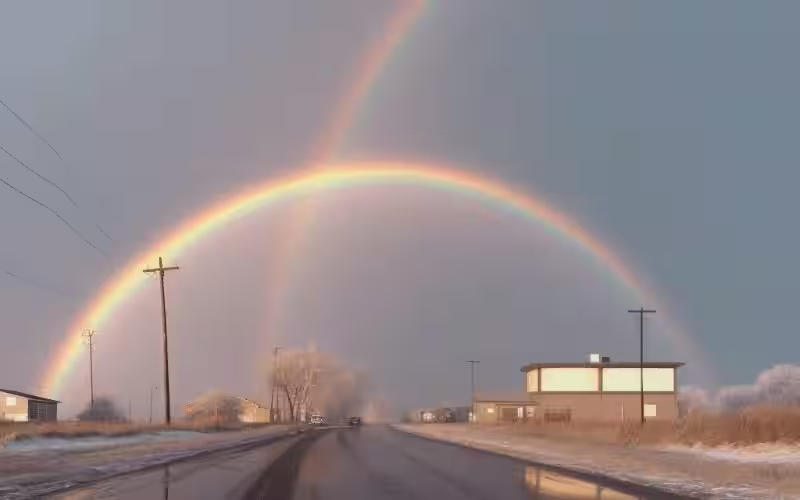
Genesis 8:21-22 and Genesis 9:11 detail God's covenant with Noah, explicitly stating He will never again use a global flood to wipe out all life. This isn't a promise to never again intervene, but specifically rules out a flood as the method of annihilation. God pledges the continuation of fundamental Earthly systems—seedtime, harvest, seasons, and day and night—indicating a commitment to the ongoing sustenance of life on Earth. The "destruction" in this context refers to the eradication of all living beings, not the planet itself.
However, contrasting prophecies emerge in books like 2 Peter 3:10 and Revelation 21:1. These passages describe a future event drastically altering Earth. 2 Peter 3:10 vividly depicts "the heavens will pass away with a roar, and the elements will be destroyed with intense heat, and the earth and its works will be burned up." Revelation 21:1 similarly speaks of "a new heaven and a new earth," implying the passing away of the current order. This paints a picture of a complete transformation, a radical reshaping of the existing reality, rather than a simple physical obliteration of the planet.
The disparity between the Genesis covenant and these later prophecies can be reconciled by clarifying the definition of "destruction." The Genesis covenant may be interpreted narrowly, specifically prohibiting a flood-based annihilation while leaving open possibilities for other forms of divine intervention. Alternatively, a broader understanding might posit that God's promise is contingent on the continuation of life on this Earth, while still allowing for a significant transformation of the planet itself. The "destruction" in 2 Peter and Revelation would then represent an event exceeding the scope of the Noahic covenant, an event transforming the Earth beyond recognition.
Several interpretations attempt to bridge this gap. Some argue that the "destruction" prophesied refers to a spiritual cleansing, a purification of the Earth, leaving the physical planet intact but fundamentally altered in its nature. Others suggest a complete physical annihilation followed by the creation of a new Earth, interpreting "new" as entirely novel and distinct from the current reality.
The key, therefore, isn't to seek a single, definitive answer but rather to understand the multifaceted nature of "destruction" within the biblical context. The type of destruction promised in Genesis is different in kind and scale from the type described in later prophetic books. The Genesis account focuses on the preservation of life via a specific method, while later accounts speak of a more profound and transformative event that could potentially alter the very fabric of existence.
The Debate: Annihilation or Renewal?
The question of whether God will "burn up" the Earth in the future is vigorously debated, with strong scriptural arguments on both sides. This hinges on the interpretation of passages describing the "passing away" of the heavens and the Earth.
The Annihilation View
Some theologians, prominently John MacArthur, advocate for a complete annihilation of the current universe followed by the creation of a new heaven and a new earth. They cite 2 Peter 3:7, 10-13 and Revelation 21:1 as crucial evidence, emphasizing the phrases "passing away" and "burned up." This view often interprets the "burning up" as a literal incineration due to the corruption caused by sin, a complete cleansing of the universe. This perspective is often linked to a belief in a literal, physical return of Christ to Earth, followed by the establishment of a new, heavenly kingdom.
The Renewal View
Conversely, other interpretations suggest a process of purification or renewal rather than complete annihilation. This view emphasizes that the Greek word often translated as "burned up" ("katakaio") can also imply "uncovered" or "laid open," a process of refining rather than complete destruction. This approach highlights verses like Ecclesiastes 1:4 ("The earth abides forever") and Ephesians 3:21 ("to him be glory in the church and in Christ Jesus throughout all generations, forever and ever, Amen.") as supporting the concept of an enduring Earth. Furthermore, the use of the word "kainos" (new) in relation to the new heaven and earth suggests a renewal of quality rather than a creation from scratch. This interpretation argues that a complete annihilation would negate God's original declaration that creation was "good" and would represent a victory for Satan.
This debate underscores the multifaceted nature of divine action and the challenge of interpreting scriptural prophecies. The issue is not simply whether God can destroy the Earth, but what form that destruction might take, and what it reveals about God's character and ultimate plan for humanity.
The Inevitability of Change: A Final Perspective
Ultimately, the biblical texts do not provide a simple answer to the question of how, or even if, God will "destroy the Earth" a second time. The prophecies speak of significant, perhaps even cataclysmic change, but the nature of that change is open to interpretation. Whether this involves a complete physical annihilation, a transformative purification, or something else altogether, remains a matter of ongoing theological discussion. Understanding the nuances of biblical language, considering different interpretations, and appreciating the mystery inherent in divine action are crucial for engaging with this complex and ultimately unanswerable question. The key takeaway is the inherent uncertainty, emphasizing the need for spiritual preparation and faith, regardless of the specific form any future divine intervention might take. Naturally, many interpretations exist, and personal faith plays a crucial role in how each individual interprets these scriptures.
Frequently Asked Questions: God’s Destruction of the Earth
Will God destroy the Earth again, like the flood?
The Bible doesn't offer a simple yes or no answer. Genesis 8:21-22 and Genesis 9:11 describe God's covenant not to destroy all life on Earth again through a global flood. However, passages like 2 Peter 3:10 and Revelation 21:1 describe a future event that radically alters or replaces the current Earth. The key is to understand the difference between destroying all life on Earth and destroying the planet itself. The Genesis covenant may be narrowly interpreted as referring only to flood destruction, leaving other possibilities open. Alternatively, it may refer to the continuation of life while the planet remains.
How will God destroy the Earth a second time?
The nature of this "destruction" is a matter of interpretation. Some understand passages like 2 Peter 3:10 ("the elements will be destroyed with intense heat, and the earth and its works will be burned up") and Revelation 21:1 ("a new heaven and a new earth") to mean a complete annihilation of the current universe, followed by creation of a new one. Others interpret references to "burning" as a metaphor for purification or radical transformation, rather than total incineration. The Greek word "katakaio," often translated as "burned up," can have different meanings depending on context. The "destruction" may be a transformative event, resulting in a radically different Earth, but not necessarily the complete physical annihilation of the planet.
Different interpretations exist. Some believe the biblical texts describing the end times point to the complete and irreversible destruction of the current Earth, followed by the creation of a "new heaven and a new earth." This view emphasizes passages where the current Earth and heavens are described as "passing away" or being consumed by fire. However, others argue that the "destruction" is metaphorical or refers to a radical transformation or purification, rather than complete annihilation. They point to verses suggesting the earth endures forever and God's pattern of preserving remnants after past acts of destruction.
What does "new heaven and new earth" mean?
This phrase, found in Revelation 21:1, is interpreted in different ways. Some understand it literally, as the complete replacement of the existing universe with a new creation. Others interpret it as a metaphorical description of a radically transformed world—a renewal, not a complete replacement, characterized by a new quality of existence, reflecting the use of the Greek word "kainos" which implies renewal rather than creation from nothing. The context of the surrounding verses is crucial in determining the most appropriate interpretation.
Is there a contradiction between God's covenant not to flood the Earth again and prophecies of its destruction?
The apparent contradiction arises from different understandings of "destruction." God's covenant in Genesis might be seen as specifically referring to flood destruction, leaving other forms of destruction open. Alternatively, it could refer to the continuation of life while the planet remains. The "destruction" in later books could be a transformative event that renders God’s original covenant moot, as the Earth in its current form ceases to exist. The temporal scope of God's promise might also be a factor.
What should I believe?
The question of how and whether God will destroy the Earth is complex and involves interpreting symbolic language and potentially contradictory passages within the Bible. A careful consideration of the different viewpoints and interpretations presented, alongside personal prayer and reflection, is crucial in forming your own understanding. There is no single, universally accepted answer.