Unlocking the Mystery: Ark of the Covenant Dimensions
Unlocking the Mystery: Ark of the Covenant Dimensions
The Ark of the Covenant, a legendary chest central to the Hebrew Bible, continues to fascinate and intrigue. One of the most persistent questions surrounding this sacred object concerns its dimensions. While the Book of Exodus provides measurements, translating these ancient units into modern equivalents proves surprisingly complex. This article explores the challenges in determining the Ark of the Covenant dimensions and presents a range of possible sizes, highlighting the inherent uncertainties involved.
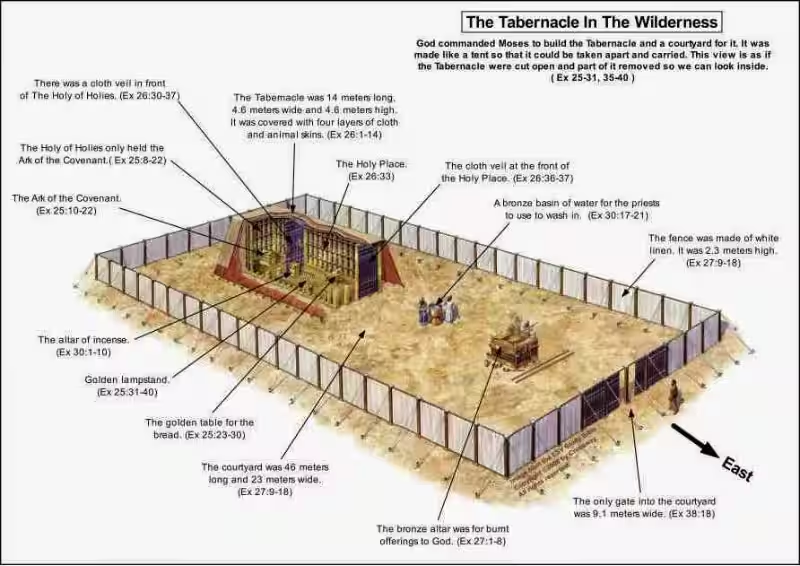
The Book of Exodus (25:10-11) describes the Ark as being made of acacia wood, overlaid with gold, with specific dimensions: two and a half cubits long, one and a half cubits wide, and one and a half cubits high. However, the ambiguity lies in defining the "cubit"—an ancient unit of length that varied considerably across different regions and time periods. There wasn't a universally standardized cubit measurement in the ancient world.
The lack of a definitive Hebrew cubit length presents a significant hurdle. Archaeological evidence suggests cubits ranged from roughly 17 to 22 inches (43 to 56 centimeters). This seemingly small difference leads to substantial variations in the calculated dimensions of the Ark. Using a shorter cubit estimate, the Ark would be closer to a small chest, while a longer cubit would result in a considerably larger structure.
The Range of Possible Sizes
This uncertainty is further compounded by the inherent ambiguity in ancient textual descriptions. The Hebrew terms for "length," "width," and "height" could be interpreted in multiple ways, adding another layer of complexity to the process of determining the Ark of the Covenant dimensions. The lack of a precise translation for these terms, in addition to the variable cubit length, highlights the importance of considering a range of possibilities rather than a single definitive answer.
Considering the lower (17-inch) cubit estimate, the Ark's dimensions would be approximately 42.5 inches (108 cm) long, 25.5 inches (65 cm) wide, and 25.5 inches (65 cm) high. A higher (22-inch) cubit estimate, on the other hand, would yield dimensions of approximately 55 inches (140 cm) long, 33 inches (84 cm) wide, and 33 inches (84 cm) high. This represents a substantial difference in size.
The Absence of Archaeological Evidence
The lack of any archaeological evidence further complicates the situation. Despite extensive archaeological discoveries in the ancient Near East, the Ark of the Covenant remains elusive. Its absence prevents any direct measurement or confirmation of the biblical descriptions. This lack of physical artifacts means any attempt to determine the Ark of the Covenant dimensions relies solely on interpreting a relatively short and potentially ambiguous textual passage. The biblical text remains our only source of information.
Interpreting the Text: Nuances and Debates
Scholars continue to debate the precise meaning of the Hebrew terms used in the biblical description. Some argue about the relative positioning of the dimensions within the Ark's construction. These subtle but significant interpretive challenges further contribute to the difficulty in pinning down exact dimensions. The lack of clear visual evidence makes it challenging to visualize the Ark's construction and the arrangement of its components.
The inherent uncertainties associated with ancient units of measurement, combined with the textual and interpretive ambiguities, lead to a range of potential sizes for the Ark. While the biblical account offers a starting point, the actual dimensions remain a matter of scholarly debate and informed speculation. The lack of physical evidence emphasizes the importance of acknowledging the inherent uncertainty in any attempt to reconstruct the Ark of the Covenant dimensions.
In conclusion, while the Book of Exodus provides the only source of information regarding the Ark of the Covenant dimensions, translating those measurements into modern units is fraught with challenges. The variations in ancient cubit lengths and the ambiguities within the biblical text itself create a wide range of possible sizes. Any attempt to define these dimensions must acknowledge the considerable uncertainties involved. Therefore, presenting a single, definitive answer is impossible. Instead, a range of possibilities, based on different interpretations of the available data, provides a more accurate and nuanced understanding of the Ark's potential size. The elusive nature of the Ark itself only adds to the enduring mystery surrounding this sacred object.
What are the dimensions of the Ark of the Covenant according to the Bible?
The Bible, specifically Exodus 25:10-11, states that the Ark was 2.5 cubits long, 1.5 cubits wide, and 1.5 cubits high. However, this is only a starting point, as the precise length of a "cubit" during that time is unknown.
What is a cubit, and why is it difficult to determine the Ark's dimensions in modern units?
A cubit was an ancient unit of measurement based on the length of a forearm. The problem is that the length of a cubit varied across different regions and time periods. Estimates for the ancient Hebrew cubit range from approximately 17 to 22 inches (43 to 56 cm). This uncertainty makes it impossible to give a single definitive answer to the Ark's dimensions in modern units.
What are the possible dimensions of the Ark of the Covenant in modern measurements?
Due to the uncertainty surrounding the length of a cubit, we can only provide a range of possible dimensions. Using the lower estimate of 17 inches per cubit, the Ark would be approximately 42.5 inches (108 cm) long, 25.5 inches (65 cm) wide, and 25.5 inches (65 cm) high. Using the higher estimate of 22 inches per cubit, the Ark would measure approximately 55 inches (140 cm) long, 33 inches (84 cm) wide, and 33 inches (84 cm) high.
Are there any archaeological findings that confirm the biblical dimensions?
No. There is no archaeological evidence to confirm the dimensions given in the Book of Exodus. The Ark of the Covenant itself has never been found, making any direct measurement impossible. Therefore, all estimations rely solely on interpreting the biblical text and the uncertain conversion of ancient units of measurement.
Why is there so much ambiguity surrounding the dimensions?
The ambiguity stems from several factors: the unknown precise length of the ancient Hebrew cubit, the potential for variations in the interpretation of the Hebrew terms used for length, width, and height, and the complete lack of archaeological evidence to verify any calculations. This makes it impossible to give a precise answer, only a range of possibilities.
Can we definitively state the Ark's dimensions?
No. Given the limitations outlined above, providing a definitive answer is impossible. Any dimensions presented should be understood as estimations based on interpretations of an ancient text and the inherently uncertain nature of converting ancient units of measurement to modern ones.